

Sold Ceramics
Sold Blue and White wares since 1722
Other wares
Page 1
Sold Ceramics - Sold Blue and White wares since 1722 - Other wares - Page 1
Object 2010558
Bowl
China
1723-1735
Height 44 mm (1.73 inch), diameter of rim 81 mm (3.19 inch), diameter of footring 36 mm (1.42 inch)
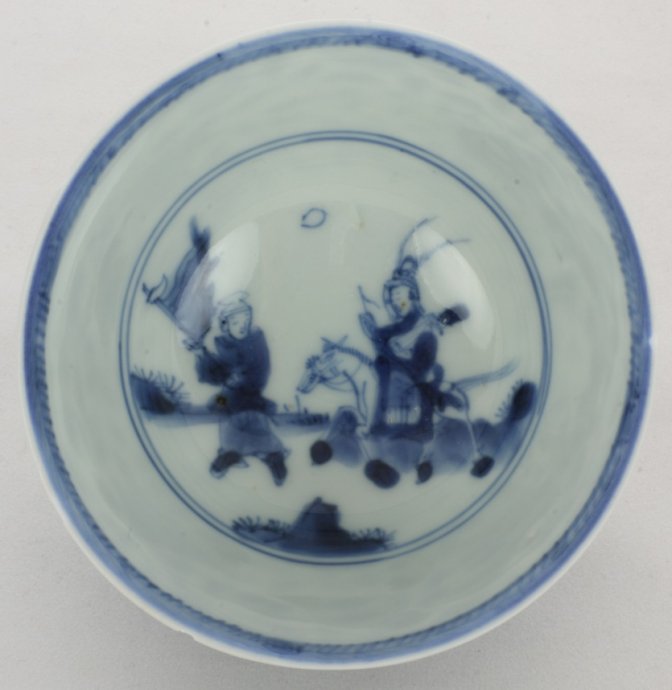
Small bowl on footring, straight sides. Decorated in underglaze blue with a continuous floral scrolls, on the bottomin a double circle, a woman with long feathers in her hair on horseback and a soldier on foot carrying a flag beside her.
The woman is Mu Guiying, wearing the long feathers of a military commander; the soldier with the large flag is an indication that the scene is taken from the novel or romance Yang-jia-jiang yanji (The Command Troops of the Yang Ye's Family) attributed to the Ming author Yong Damu whose other names are Zhonggu and Aufeng. The story tells of a female warrior Mu Guiying, of low birth, who is determined to marry the sixth son of Yang Ye, one of the Son's Emperor's most esteemed generals who was betrayed by court officials and died while fighting the invading Kithan tribes. The girl was denied her wish, but she captures the son, Yang Zhongbao, and will not let him go unless he agrees to marriage. Her martial skills earn her much respect and eventually, when the men of the Yang family have been defeated in battle, she successfully leads an army of female warriors against the Kithan Liao invasion in the north.
In the collection of the Rijksmuseum Amsterdam, two bottles are decorated with various scenes from this same novel or romance. (Jörg & Van Campen 1997, pp.91-92, cat. 79)
For an in famille verte enamels decorated dish with this scene, please see:
Condition. A firing flaw to the exterior wall, some tiny fleabites and a glaze chip to the rim.
References:
Jörg & Van Campen 1997, cat. 79
Price: Sold.
Sold Ceramics - Sold Blue and White wares since 1722 - Other wares - Page 1
Object 2010273
Covered jar
China
c.1750
Height 72 mm (2.84 inch), diameter of rim 70 mm (2.76 inch), diameter of footring 40 mm (1.57 inch)
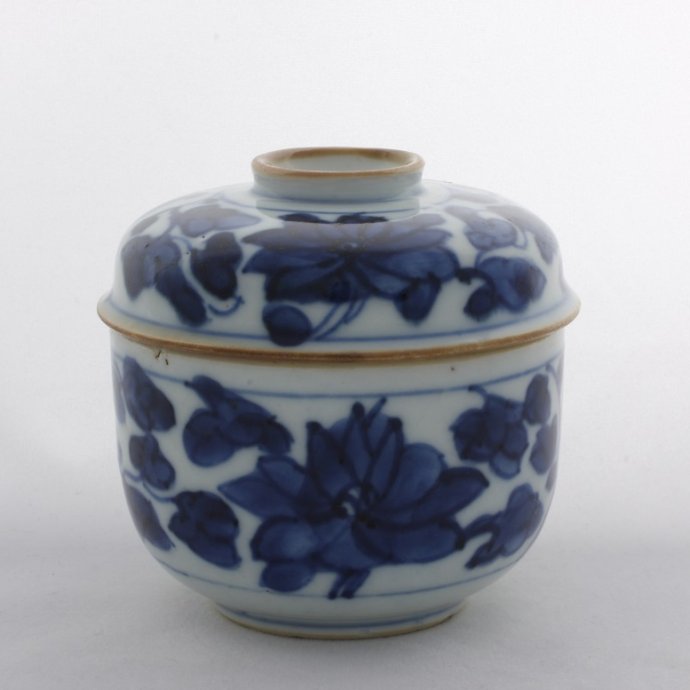
A covered jar on footring. domed cover with ring knob. The cover with an underglaze brown-edged rim (jia mangkou). Decorated in underglaze blue with lotus flower heads alternating with leafy scrolls. The cover is decorated en suite.
Condition: A "Y" shaped glaze hairline to the inner wall, only visible on the inside of the box and a tiny hairline to the rim of the cover.
Reference:
Price: Sold.
Sold Ceramics - Sold Blue and White wares since 1722 - Other wares - Page 1
Object 201033
Klapmuts (Bowl)
China
1735-1745
Height 55 mm (2.17 inch), diameter of rim 95 mm (3.74 inch), diameter of footring 37 mm (1.46 inch), weight 86 grams (3.03 ounce (oz.))
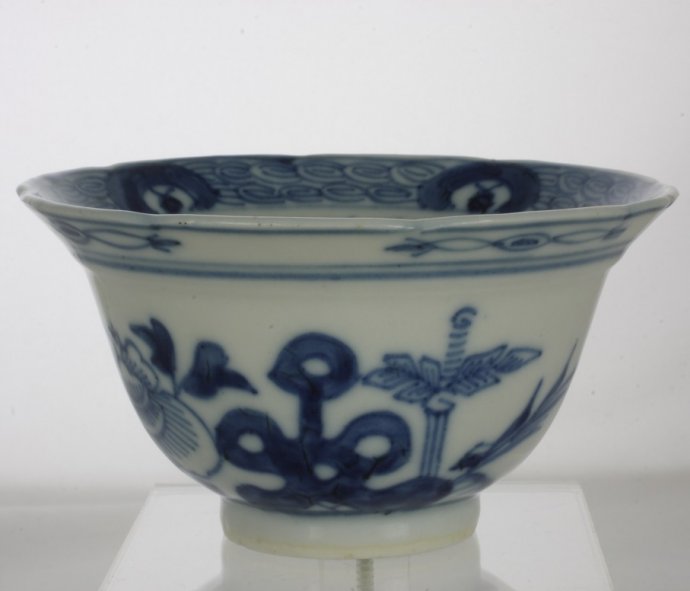
Klapmuts or bowl on footring, flattened rim with with eight small indentations, decorated in underglaze blue with a flowering peony growing from pierced taihu (garden) rockwork and a single butterfly in flight on the rim with four flower sprays. On the inner rim five cartouches reserved on a cloud-pattern border and on the bottom a single lingzhi.
Condition: A tiny firing flaw to the footring and two fleabites to the rim.
Price: Sold.
Sold Ceramics - Sold Blue and White wares since 1722 - Other wares - Page 1
Object 2011692
Bowl
China
1850 or later
Provenance: The George Eumorfopoulos Collection of Chinese, Corean & Persian Pottery & Porcelain.
Height 57 mm (2.20 inch), diameter of rim 146 mm (5.59 inch), diameter of footring 46 mm (2.20 inch), weight 144 grams (5.08 ounce (oz.))
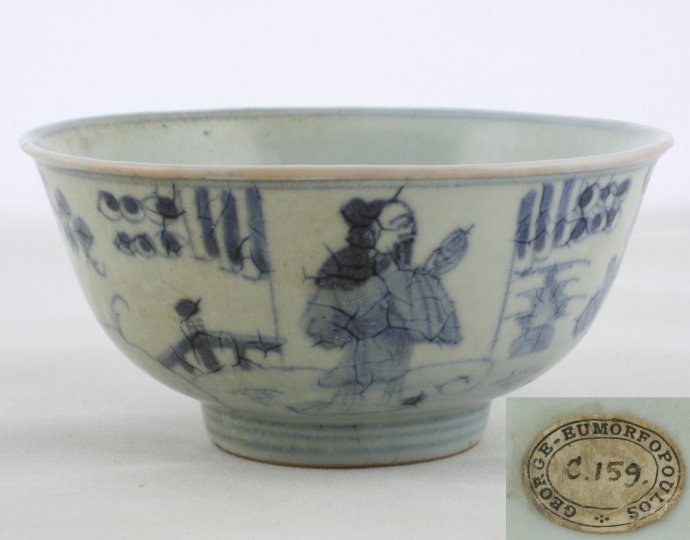
Bowl on footring, slightly flaring rim. Decorated in underglaze blue with the Taoist Triad, three figures representing Tu (happiness), Lu (Official Advancement) and Shou (Longevity) in a fenced garden landscape. The interior with a stylised pine tree, a deer and lingzhi in a double circle. Marked on the base with the highly stylised four character mark Hung-hsi, nien chieh. On the interior wall an old oval paper collectors label from George Eumorfopoulos with the handwritten collectors number C.159, in black ink.
The design on this bowl is unusual and the stylised mark can be considered extremely rare. The bowl is apparently over fired creating the cracked ice motif of the glaze.
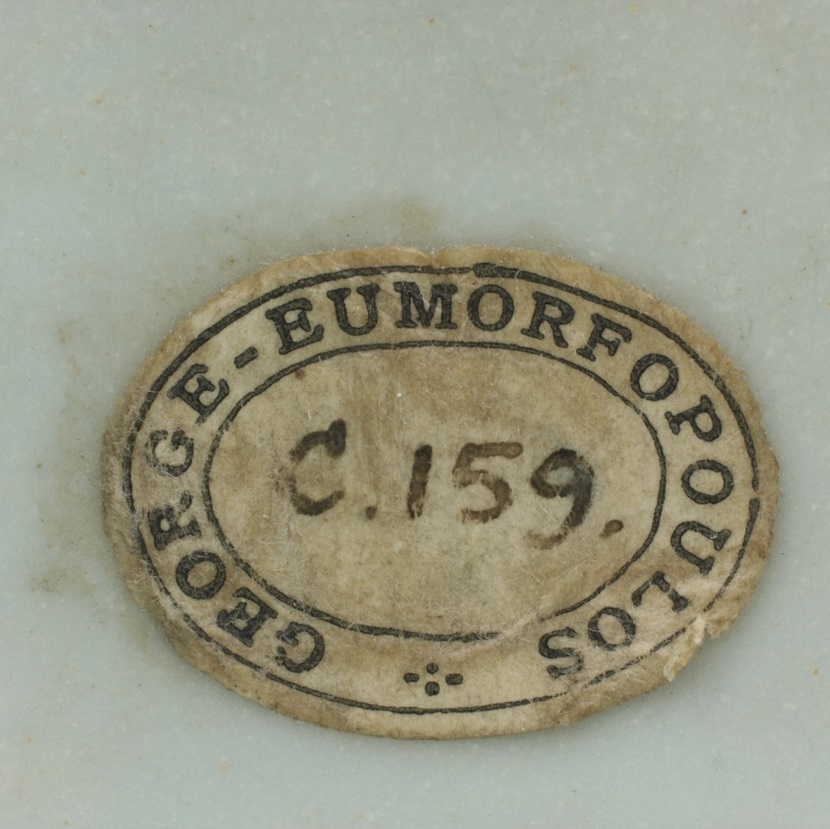
George Eumorfopoulos was a distinguished collector of European and Oriental porcelain. He was born in Mount Pleasant, Liverpool, on 18 April 1863, the son of Aristides George Eumorfopoulos and Mariora Scaramanga. He worked for the merchant firm of Ralli Brothers, where he rose to the position of Vice-President before retiring in 1934. He initially collected European porcelain before moving on to create a renowned collection of early Chinese art, encompassing porcelain, archaic bronzes and jades, and sculpture and paintings. Eumorfopoulos turned a part of his house on Chelsea Embankment into a private museum to display these works of art, which attracted many visitors. Eumorfopoulos was a member of the Victoria & Albert’s Advisory Council from 1925 to 1935, and was a founder of the Oriental Ceramic Society and its first president from 1921 until his death in 1939. In 1934 he sold his collection at below market value to the British Museum and the Victoria and Albert Museum. (source: www.vam.ac.uk)
In the 1920's this bowl was regarded as export quality and dated 15th Century. The original George Eumorfopoulos collectors label states that this bowl was considered to be special enough by a collector of the stature of George Eumorfopoulos to take this bowl up in his prestigious collection. In Hobson's 'The George Eumorfopoulos Collection of Chinese, Corean & Persian Pottery & Porcelain' (1925-1928) the whole C-section is about early ceramics (Chün) but it does not include a number C.159. To my knowledge there have been no later subsequent catalogus created-except for the Bluett & Sons's 'Chinese Pottery and Porcelain from the Eumorfopoulos Collection' (1935) sale catalogue and the Sotheby's 'The Eumorfopoulos Collections. Catalogue of Persian Ceramics & Islamic Glass, Egyptian, Greek and Roman Antiquities, Choice Medieval & Renaissance Works of Art etc. formed by the late George Eumorfopoulos.'' (1940)
It is now recognised as an academically interesting piece of provincial Chinese blue-and-white made for the domestic market in Fujian Province (i.e. not in Jingdezhen) a lesser known manufacturing centre. It can be dated mid or second half 19th Century.
Condition: Perfect.
Reference:
Price: Sold.
 create websites