

Chinese Porcelain
Ko-Sumetsuke wares early 17th century
Sometsuke is a type of blue-and-white porcelain-ware that was produced during early 17th century in privately owned kilns in Jingdezhen a town in Jiangxi Province, China. Ko-sometsuke the prefix 'Ko' meaning 'old', is the Japanese name for Sometsuke imported from China to Japan. Though sometsuke was not made using high quality clay or glazes, the free-spirited decorations and designs made it popular in Japan. They were particularly sought after by tea-ceremony masters to be used as utensils. (source: E-Budo.com, J. Lindsey.)
Ko-Sumetsuke wares early 17th century - Page 1
Object 2012561
Dish
China
1630-1640
Height 29 mm (1.14 inch), diameter of rim 211 mm (8.31 inch), diameter of footring 108 mm (4.25 inch), weight 330 grams (11.64 ounce (oz.))
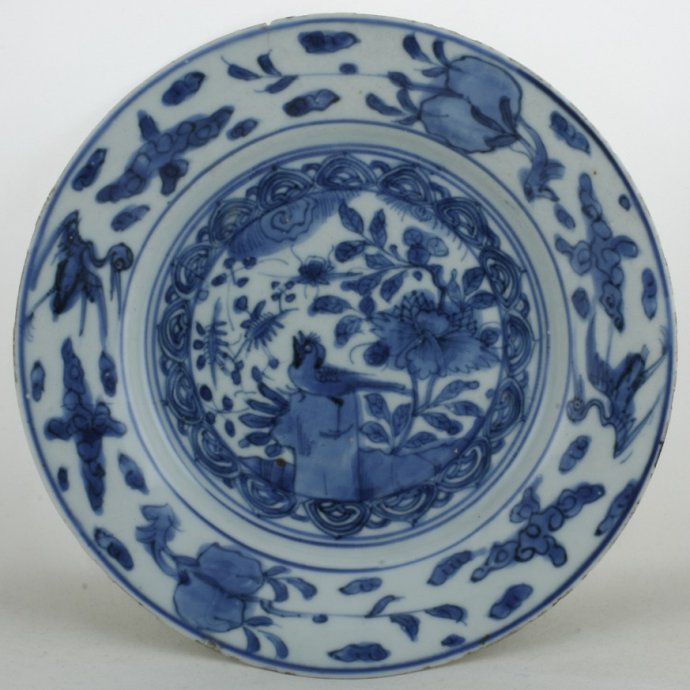
Dish on footring, flat rim. Decorated in underglaze blue with a bird perched on a rock with a flowering peony tree and an insect in flight in a central medallion enclosed by a ruyi-heads pattern border. The sides are undecorated. On the rim stylized cranes flying amongst swirling clouds alternating with fruiting peach sprays. On the exterior rim four elongated grasses. On the base two concentric lines in underglaze blue. Coarse sand from the kiln adheres to the base and some areas of the footring.
For and identically shaped, sized and decorated dish in the collection of Oriental Ceramics of the Groninger Museum, please see:
For a closely related border to that enclosing the central medallion of the dish, formed by a narrow band of alternating blue and white squares and a band of ruyi-heads, please see:
Condition: A firing flaw to the footring, some glaze rough spots, a shallow glaze chip and a chip with a short, connected hairline all to the rim.
Reference:
Collection Groninger Museum, Objectnumber 2016.0075
Price: € 999 Currency Converter
 create websites