

Sold Ceramics
Sold Japanese wares with Western Designs 1653-1800
Frederik van Frijtom
Frederik van Frijtom (c.1632-1702)
Frederik van Frijtom (c.1632-1702) was a Delft faience painter who specialised in plates, dishes and plaques with landscapes in blue. The elements that characterise his work include the wide blank rims of his plates and dishes, the detailed painting of trees and landscapes, and a specific way of drawing clouds, outlining them with small bows. His work shows idyllic, pastoral scenes with people riding horses, fishing from a boat, walking or hunting. Other Delft factories made pieces with similar scenes (and related scenes feature in the work of Dutch engravers and artists of that period), but Van Frijtom produced pieces of outstanding quality. He seemed to have made single items only, because no two pieces of the same design are known. It is possible that faience from his workshop reached Japan as a model for a private commission. In fact, some Delftware pieces that obviously served as models for Japanese porcelain copies do exist. Until the 1960s the five delftware originals of these dishes were in a Japanese collection, housed in a specially made wooden box, as tea ceremony utensils were customarily kept. They are now in the Prinsenhof Municipal Museum in Delft. These are four small irregular shaped faience dishes and one round saucer, painted in blue with typical Frijtom Scenes. They are all marked 'MB' on the back and dated 1684 in blue. very similar copies were made of four of these in Japanese porcelain. the Japanese copies usually have a spurious four - or six-character Chinese Chenghua.
There is a problem here, however. The 'MB' initials on the delftware pieces are not related to any of Van Frijtom's marks, although they could have been the initials of the commissioner. Vecht assumes these Delft pieces were made for the Japanese tea ceremony, i.e., that a Dutchman ordered them as gifts for the Japanese. Faience was occasionally ordered in Delft for Japanese noblemen and officials, and even Delftware tea bowls in Japanese style are known. Vecht acquired the five saucers at auction in Japan. So his assumption might be true. However, if they were in Japanese possession, why would copies have been made for export? That porcelain copies were made for export is obvious. Similar pattipans and tea bowls and saucers with these designs are known from several old European collections, including Burghley House in Stamford. One saucer was even copied in the 18th century in Chinese and in English Bow porcelain. It may be that the dated Delftware pieces were first used as models and presented to the Japanese afterwards, although this is hypothetical as we have no documentation of such wares being ordered in Arita.
The popularity of this style in the 18th century brings us to the problem of dating. If the Delft saucers were made in 1684 and sent to Japan as models, the copies could have date to the late 1680s or early 1690s. However, in my opinion such a date does not correspond with the overall pictures of Japanese export porcelain at that time. The 'atmosphere' and 'feel' of the copies is different, the glaze, the rather violet blue and the painting all suggests a slightly later date.
Closely related in style, however, is the so-called Scheveningen design, of which plates, dishes and bowls are known. It shows a Dutch dune landscape with figures in foreground and a village, a beacon and sails in the background. The sky is decorated with clouds with curly outlines as on the pieces discussed above.
Dating this specific group with the Scheveningen design is easier because examples have different square marks, usually fuku (good luck) marks, but others as well. Japanese scholars have established dates for these marks, enabling us to suggest c. 1700 or the early 18th century as the period when this group was produced, although it might have lingered for a while. Due to the similarities in subject and style of painting, this makes it plausible that the first group of 'Frijtom' style pieces were also made in the same period. (New York 1986, pp.161-162), (Jörg 2003/1, p.211-212)
It is unknown when and where Van Frijtom was born. He married Lijntge Stevens, a spinster from Pernis, in Delft in 1652. They lived in 'In den gulden Brack' in the Molslaan in Delft, and had several children. He was doing well and bought real estate in Delft several times. After his wife died he married again with Elisabeth Verschouw, under a prenuptial agreement. His works are known from 1652 to 1702. He made paintings, often landscapes, mostly on panel and sometimes on canvas. However, he specialized for the Delft pottery industry in plate decorations and tile paintings. He found original decorative possibilities without using the usual symbols. A will in 1701 showed that he was ill. After his death in 1702, twelve porters carried him to his grave in the Nieuwe Kerk in Delft. (Wikipedia)
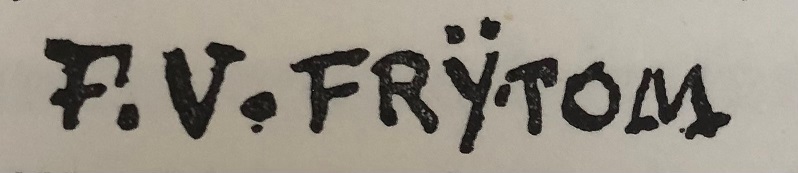
Reproduced from: Frederik van Frytom 1632-1702. Life and work of a Delft pottery-decorator. (A. Vecht, Scheltema & Holkema N.V., Amsterdam, 1968), p.26. This autograph is not included in this sale/offer. (copyright in bibliographic data and images is held by the publisher or by their respective licensors: all rights reserved)
The following series of small shaped dishes and tea bowls have in the past been relegated by most authorities to the no-man's land of nineteenth century. There is no doubt that they are closely related to each other in terms of body, past, style of decoration and marks. Most of them are direct of Dutch Delftware originals painted in the so-called 'Van Frijtom' style and are illustrate by Vecht in his monograph Frederik van Frijtom.The author suggests that they were made for the Tea Ceremony which may not be the case. They certainly must have appeared strange to the Arita potters, who were used to the more clumsily painted pottery (i.e. Delft) or wooden prototypes. These were invariably based on the schematic cartoon-like subjects derived from Chinese Transitional wares. In contrast the Delft originals which bear the monogram MB and date 1684 are executed in contemporary Dutch or Flemish style with an almost miniaturist's detail utilising and shadow, a technique unfamiliar to Oriental artists. (The Chinese being the first to learn the rudiments of this art from the Jesuit, Castiglione in about 1715.) (Stamford 1981, p.11)
The bases of the Arita dishes and tea bowls have four or six character marks closely akin to the rather slovenly drawn retrospective marks on contemporary Chinese blue and white teawares of the Kangxi (1662-1722) period.
That these Arita dishes and tea bowls were manufactured in either the late seventeenth or eighteenth century and not over one hundred years later when out of fashion is evidenced by a series of small dishes made at the Bow factory in East London from about 1752. Not only did the factory copy the scalloped edge dishes but also used some of the designs on other flatware. An oval dish painted with the quay scene within a wavy blue border is illustrated by Elizabeth Adams and David Redstone in Bow Porcelain plate 90.
A final point, the marks painted by the Bow workmen could only have been copied from the Arita dishes as neither the delft nor the later Chinese Qianlong copies possess them. The sequence would therefor be Delft, Japan and finally Bow. (Stamford 1981, p.11)
Sold Ceramics - Sold Japanese wares with Western Designs 1653-1800 - Frederik van Frijtom
Object 2010749
Dish
Japan
c.1700
Height 27 mm (1.06 inch), diameter of rim 195 mm (7.68 inch), diameter of footring 120 mm (4.72 inch)
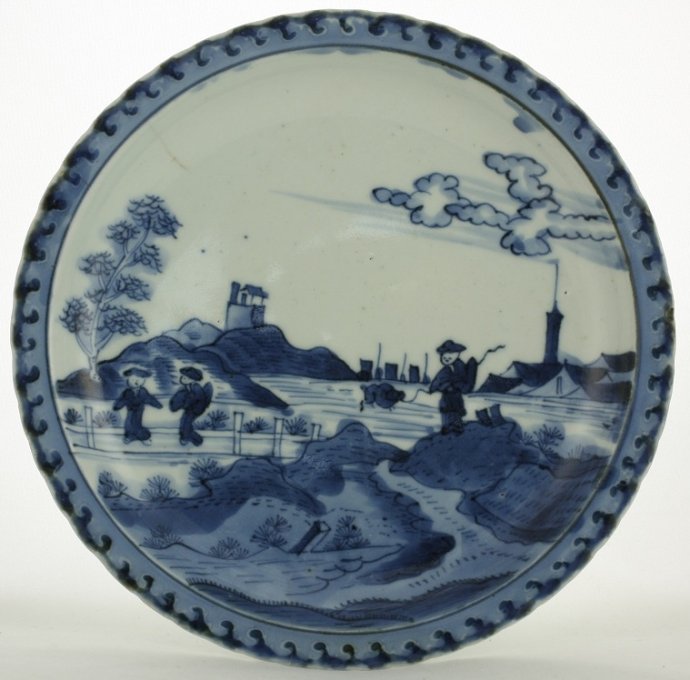
Dish on footring, flat rim with a moulded, wavy, edge in relief. On the base four spur-marks in a Y-pattern. Decorated in underglaze blue with a village with a church and houses, a lighthouse with trees, figures with a cow, and the poles with clouds. The slightly crimped rim is painted with a wave-scroll border. On the reverse three sprays of flowering branches. The low footring is encircled with a double concentric band.
This design on this dish has traditionally been called 'Deshima' or 'Scheveningen'. It certainly does not depict the Dutch factory in Deshima (Nagasaki), a fan-shaped, man-made island in Japan to which Westerners were restricted between 1641 and 1862. Scheveningen, a fishermen´s village on the Dutch coast near The Hague, is a more appropriate name. In fact 47 "Scheveningen" plates were already mentioned in the 1778 sale catalogue of the porcelain shop of Martha Raap in Amsterdam, clearly indicating this type. Research was undertaken to find the print that was used as a model, non with this view have come to light. it is therefore possible that another source was used, maybe a plate or dish in the so-called Frijtom style. This is the most common version of this design, later copied by the Chinese. The design, almost certainly copied from a drawing by Frederick van Frijtom (1652-1702), was highly popular in The Netherlands, and possibly also in Japan as a kind of Western exoticism. The rim design is unique in Chinese export porcelain and is almost certainly after a silver original. (Howard & Ayers 1978, vol. 1, pp.72-73), (Terwee 1989, pp.494-501), (Jörg 2003/1, p.240)
These dishes with the so called 'Deshima' or 'Scheveningen' design first appeared, in underglaze blue, on Japanese dishes of around c.1700. In the collection of the Groninger Museum is a blanc Chinese porcelain dish overdecorated in Delft (the Netherlands) c.1700-1730 with identical design. This dish is an original Japanese version. (Jörg 2003/1, cat. 307a)
For identically shaped and decorated dishes, please see:
- Japanese Porcelain, (S. Jenyns, Faber & Faber, London / Boston, 1979), cat. 19a, (ii).
- Porcelain for Palaces. The Fashion for Japan in Europe 1650-1750, (J. Ayers, O. Impey & J.V.G. Mallet, Oriental Ceramic Society & The British Museum, London 1990), p.276, cat. 324.
- Ko-Imari from the collection of Oliver Impey, (Barry Davies Oriental Art, London, 1997), p. 113, cat. 67.
- The Voyage of Old-Imari Porcelains: Exhibition Catalogue of the Kyushu Ceramic Museum, Arita 2000, cat. 72.
- Complete Catalogue of the Shibata Collection, (The Kyushu Ceramic Museum, Kyushu 2003), p.326, cat. 2549.
- Faszination des Fremden: China - Japan - Europa, (D. Antonin & D. Suebsman, Hetjens-Museum, Deutsches Keramikmuseum Düsseldorf, 2009), pp.242-243, cat. 98.
For a similarly, sold, Chinese version, please see:
Condition: Three hairlines to the rim.
References:
Lunsingh Scheurleer 1971, cat. 65
Ayers, Impey & Mallet 1990, cat. 324
Antonin & Suebsman 2009, cat. 98
Price: Sold.
More pictures of object 2012173, another identically, shaped, sized and decorated, sold dish >>
Sold Ceramics - Sold Japanese wares with Western Designs 1653-1800 - Frederik van Frijtom
Object 2012316
Saucer
Japan
c.1700
Height 22 mm (0.87 inch), diameter of rim 128 mm (5.04 inch) x 103 mm (4.06 inch), diameter of footring 80 mm (3.15 inch) x 62 mm (2.44 inch), weight 76 grams (2.68 ounce (oz.))
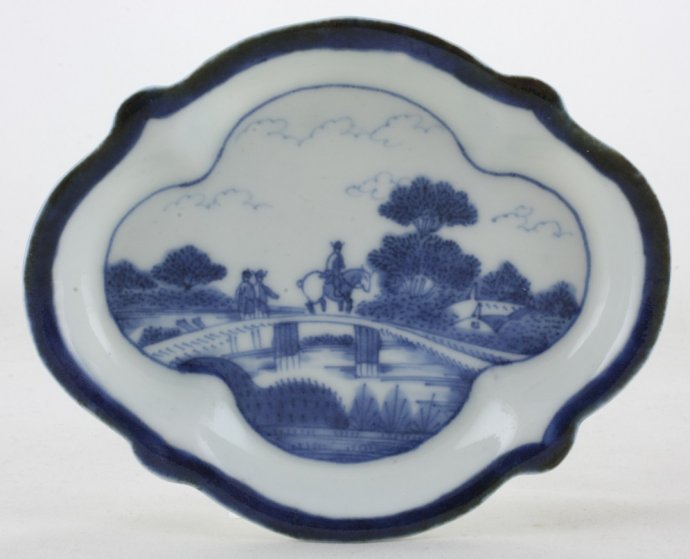
Saucer or pattipan of lobed oval shape on a four-lobed footring. Decorated in underglaze blue with a European landscape with trees, a house and a bridge with two men and a horseman. Round the rim a dark blue border. The reverse in undecorated. Marked on the base with a six-character Chenghua mark.
The Frederik van Frijtom (c.1632-1702) style.
The Groninger Museum has two interesting, very rare early plates, each with a design clearly taken from a Delftware example, and it is tempting to connect them to the models brought over from The Netherlands in 1662. The Japanese copied not only the decoration from the Delft pieces, but also the flat base without a footring. They may represent a short-lived fashion, as it is difficult to find other examples of Dutch style decorations in the second half of the 17th century, apart from the pieces mentioned above.
Then, unexpectedly, there was a varied output of pieces painted with Dutch landscapes, ships and harbour scenes in underglaze blue - no polychrome examples are known. Shapes include teapots. teacups and saucers, pattipans (saucers for teapots and milk jugs), plates and bowls. This type of decoration has been labelled the 'Frijtom' style.
This saucer or pattipan (a stand for a teapot or milk jug, or used as spoon tray) belongs to another category within the 'Frijtom' Group. The shape and decoration imitate a Delftware model in the Prinsenhof Museum, Delf, painted in the Frijtom style and dated to 1684, as part of a set of five different saucers. The motif of the horseman, the main element of the design, is also seen on other export ware. Two teacups with this design are in the Amsterdam Rijksmuseum (Arita 2000, cat.70); two others from the Gerry Collection are in the Metropolitan Museum of Art, New York (Ford 1989).
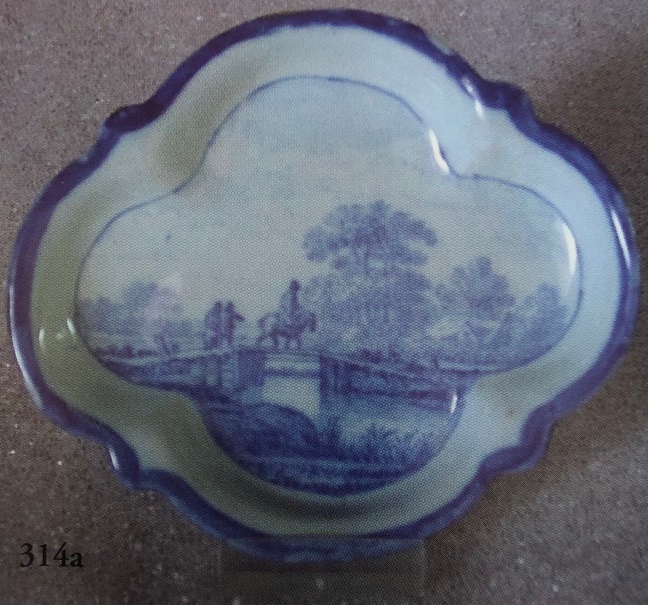
In his Fine & Curious on page 244, cat. 314a Jörg shows an example of an Dutch Delftware saucer, on the flat surface, within a blue line, a water landscape with a wooden bridge on which there is a horseman followed by two other men. To the right in the distance tall trees and a farmhouse. Blue border. Marked on the base: MB 1684, Prinsenhof Museum, Delft TDA126c. Reproduced from: Fine & Curious. Japanese Export Porcelain in Dutch Collections, (C.J.A. Jörg, Hotei Publishing, Amsterdam, 2003), p.244, cat. 314a. This saucer is not included in this sale/offer. (copyright in bibliographic data and images is held by the publisher or by their respective licensors: all rights reserved)
It is a curiosity that these Japanese dishes / saucers were in turn copied in England at the Bow factory from c.1752 and there is even a Chinese version in the Ashmolean Collection. (Ayers, Impey & Mallet 1990, p.114, Impey 2002, p.228 )
For an identically shaped and decorated saucers, please see:
- The Wrestling Boys. Chinese and Japanese Ceramics from the 16th to the 18th Century in the Collection at Burghley House, (The Trustees of Burghley House, Stamford 1981), p.12, cat. 36.
- The Burghley Porcelains: An Exhibition from the Burghley House Collection and based on the 1688 Inventory and 1690 Devonshire Schedule (Japan Society Gallery, New York in collaboration with the Burghley House Preservation Trust Ldt., June 1986), pp.160-161, cat. 55.
- The Voyage of Old-Imari Porcelains, (Kyushu Ceramic Museum, Arita 2000), p.47, cat. 39.
- Fine & Curious: Japanese Export Porcelain in Dutch Collections, (C.J.A. Jörg, Hotei publishing, Amsterdam, 2003), p.244, cat. 314.
For an originally shaped and decorated Delftware saucer, please see:
- Frederik van Frytom 1632-1702. Life and work of a Delft pottery-decorator. (A. Vecht, Scheltema & Holkema N.V., Amsterdam, 1968), p.77, cat.43.
- The Wrestling Boys. Chinese and Japanese Ceramics from the 16th to the 18th Century in the Collection at Burghley House, (The Trustees of Burghley House, Stamford 1981), p.13, cat. 38.
- Fine & Curious: Japanese Export Porcelain in Dutch Collections, (C.J.A. Jörg, Hotei publishing, Amsterdam, 2003), p.244, cat. 314a.
Condition: Poor, professionally restored after being broken in two pieces, also a filled chip to the reverse rim.
References:
Stamford 1981, cat. 36 & cat. 38
Ayers, Impey & Mallet 1990, p.114
Jörg 2003/1, cat. 314 & cat. 314a
Price: Sold.
Sold Ceramics - Sold Japanese wares with Western Designs 1653-1800 - Frederik van Frijtom
Object 2012717
Tea bowl
Japan
c.1700
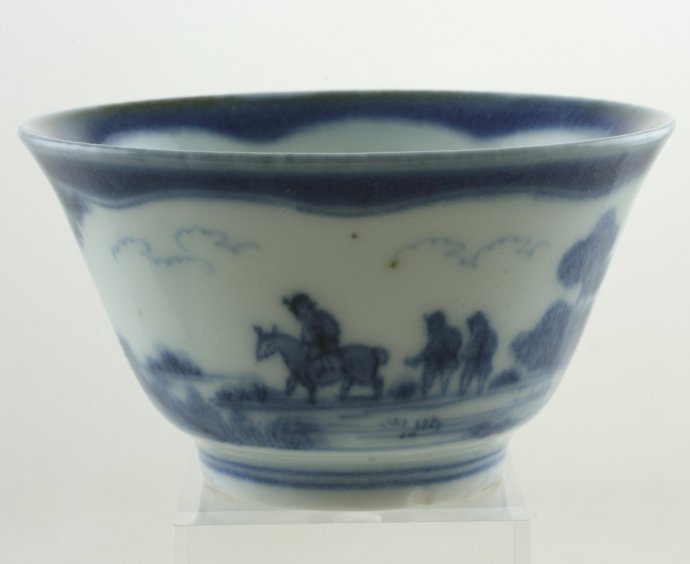
Height 42 mm (1.65 inch), diameter of rim 75 mm (2.95 inch), diameter of footring 33 mm, (1.30 inch),
weight 50 grams (1.76 ounce (oz.))
Tea bowl on footring, spreading sides, everted rim. Decorated in underglaze blue with a European dune landscape showing a horseman and two travellers on foot crossing a heath. Round the rim a wavy blue border that is repeated on the inside. In the centre a house with a pine tree. On the base a four-character Chenghua mark.
he Frederik van Frijtom (c.1632-1702) style.
The Groninger Museum has two interesting, very rare early plates, each with a design clearly taken from a Delftware example, and it is tempting to connect them to the models brought over from The Netherlands in 1662. The Japanese copied not only the decoration from the Delft pieces, but also the flat base without a footring. They may represent a short-lived fashion, as it is difficult to find other examples of Dutch style decorations in the second half of the 17th century, apart from the pieces mentioned above.
Then, unexpectedly, there was a varied output of pieces painted with Dutch landscapes, ships and harbour scenes in underglaze blue - no polychrome examples are known. Shapes include teapots. teacups and saucers, pattipans (saucers for teapots and milk jugs), plates and bowls. This type of decoration has been labelled the 'Frijtom' style.
This saucer or pattipan (a stand for a teapot or milk jug, or used as spoon tray) belongs to another category within the 'Frijtom' Group. The shape and decoration imitate a Delftware model in the Prinsenhof Museum, Delf, painted in the Frijtom style and dated to 1684, as part of a set of five different saucers. The motif of the horseman, the main element of the design, is also seen on other export ware. Two teacups with this design are in the Amsterdam Rijksmuseum (Arita 2000, cat.70); two others from the Gerry Collection are in the Metropolitan Museum of Art, New York (Ford 1989).
In his Fine & Curious on page 244, cat. 314a Jörg shows an example of an Dutch Delftware saucer, on the flat surface, within a blue line, a water landscape with a wooden bridge on which there is a horseman followed by two other men. To the right in the distance tall trees and a farmhouse. Blue border. Marked on the base: MB 1684, Prinsenhof Museum, Delft TDA126c. Reproduced from: Fine & Curious. Japanese Export Porcelain in Dutch Collections, (C.J.A. Jörg, Hotei Publishing, Amsterdam, 2003), p.244, cat. 314a. This saucer is not included in this sale/offer. (copyright in bibliographic data and images is held by the publisher or by their respective licensors: all rights reserved)
It is a curiosity that these Japanese dishes / saucers were in turn copied in England at the Bow factory from c.1752 and there is even a Chinese version in the Ashmolean Collection. (Ayers, Impey & Mallet 1990, p.114, Impey 2002, p.228 )
For identically shaped, sized and decorated tea bowls, please see:
- Frederik van Frytom 1632-1702. Life and work of a Delft pottery-decorator. (A. Vecht, Scheltema & Holkema N.V., Amsterdam, 1968), p.77, cat. 44.
- The Wrestling Boys. Chinese and Japanese Ceramics from the 16th to the 18th Century in the Collection at Burghley House, (The Trustees of Burghley House, Stamford 1981), p.15, cat. 42.
- The Burghley Porcelains: An Exhibition from the Burghley House Collection and based on the 1688 Inventory and 1690 Devonshire Schedule (Japan Society Gallery, New York in collaboration with the Burghley House Preservation Trust Ldt., June 1986), pp.158-159, cat. 54.
- The Voyage of Old-Imari Porcelains, (Kyushu Ceramic Museum, Arita 2000), p.48, cat. 70.
Condition: A frit to the footring.
References:
Ayers, Impey & Mallet 1990, p.114
Price: Sold.
Sold Ceramics - Sold Japanese wares with Western Designs 1653-1800 - Frederik van Frijtom
Object 2012716
Saucer
Japan
c.1700
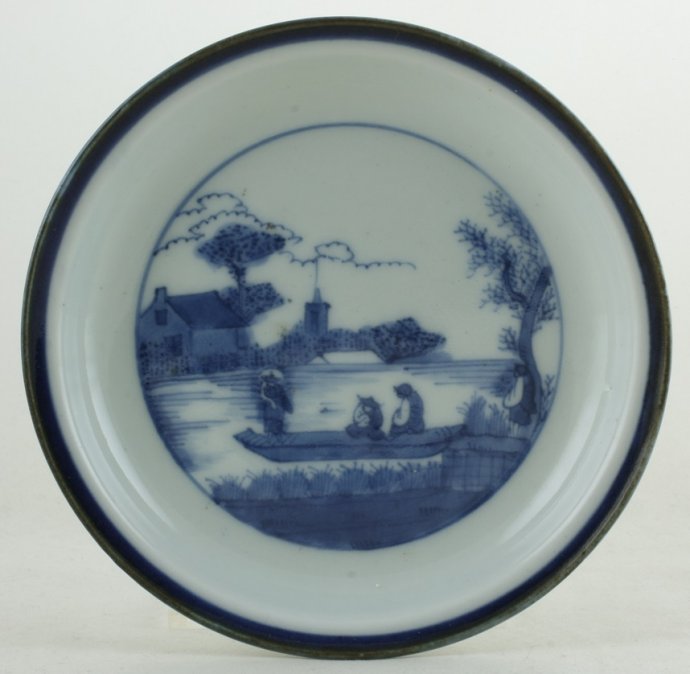
Height 24 mm (0.94 inch), diameter of rim 125 mm (4.92 inch), diameter of footring 60 mm, (2.36 inch), weight 111 grams (3.91 ounce (oz.))
Saucer on footring with a narrow flat rim and a slightly upturned edge. Decorated in underglaze blue with a European river scene showing a boat with three figures, another figure is standing near a tree on the river-bank. On the opposite bank a house and a church. Curling clouds in the sky. Round the rim a blue border. On the base a six-character Chenghua mark.
The decoration on this saucer imitated the Delftware model in the Prinsenhof Museum, Delft. Sherds of saucers with this design have been found at Deshima. Twickel Castle in Delden has five identically shaped, sized and decorated tea bowls and saucers. (Arita 2000, cat. 73), (Jörg 2003/1, p.246, cat, 317)
The Frederik van Frijtom (c.1632-1702) style.
The Groninger Museum has two interesting, very rare early plates, each with a design clearly taken from a Delftware example, and it is tempting to connect them to the models brought over from The Netherlands in 1662. The Japanese copied not only the decoration from the Delft pieces, but also the flat base without a footring. They may represent a short-lived fashion, as it is difficult to find other examples of Dutch style decorations in the second half of the 17th century, apart from the pieces mentioned above.
Then, unexpectedly, there was a varied output of pieces painted with Dutch landscapes, ships and harbour scenes in underglaze blue - no polychrome examples are known. Shapes include teapots. teacups and saucers, pattipans (saucers for teapots and milk jugs), plates and bowls. This type of decoration has been labelled the 'Frijtom' style.
It is a curiosity that these Japanese dishes / saucers were in turn copied in England at the Bow factory from c.1752 and there is even a Chinese version in the Ashmolean Collection. (Ayers, Impey & Mallet 1990, p.114, Impey 2002, p.228 )
For identically shaped, sized and decorated (tea bowls) and saucers, please see:
- Frederik van Frytom 1632-1702. Life and work of a Delft pottery-decorator. (A. Vecht, Scheltema & Holkema N.V., Amsterdam, 1968), p.77, cat. 44.
- The Wrestling Boys. Chinese and Japanese Ceramics from the 16th to the 18th Century in the Collection at Burghley House, (The Trustees of Burghley House, Stamford 1981), p.13, cat. 38.
- The Burghley Porcelains: An Exhibition from the Burghley House Collection and based on the 1688 Inventory and 1690 Devonshire Schedule (Japan Society Gallery, New York in collaboration with the Burghley House Preservation Trust Ldt., June 1986), pp.158-159, cat. 56.
- The Voyage of Old-Imari Porcelains, (Kyushu Ceramic Museum, Arita 2000), p.49, cat. 73.
- Fine & Curious: Japanese Export Porcelain in Dutch Collections, (C.J.A. Jörg, Hotei publishing, Amsterdam, 2003), p.246, cat. 317.
Condition: A frit to the footring.
References:
Ayers, Impey & Mallet 1990, p.114
Price: Sold.
 create websites