

Sold Ceramics
Sold Japanese Tea, Coffee and Chocolate wares 18th Century
Page 4
Sold Ceramics - Sold Japanese Tea, Coffee and Chocolate wares 18th Century - Page 4
Object 2012455
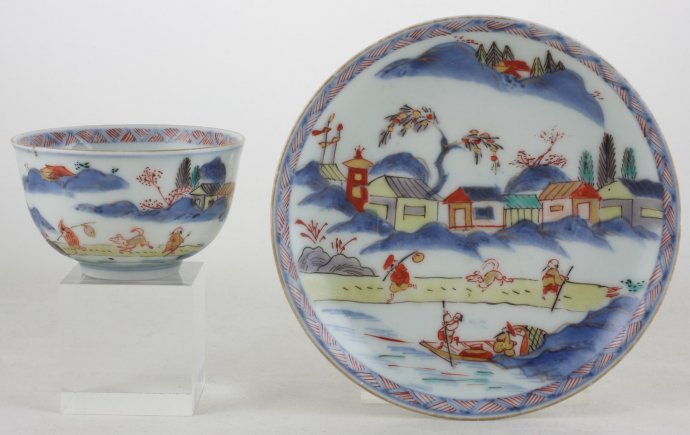
Tea bowl and saucer
Japan
1700-1720
Height of tea bowl 41 mm (1.61 inch), diameter of rim 70 mm (2.76 inch), diameter of footring 23 mm (0.91 inch), weight 40 grams (1.41 ounce (oz.))
Height of saucer 21 mm (0.83 inch), diameter of rim 119 mm (4.69 inch), diameter of footring 63 mm (2.48 inch), weight 87 grams (3.07 ounce (oz.))
Tea bowl and saucer on footrings, straight sides with slightly flaring rims. Imari decorated in underglaze blue, iron-red, black, gold and various other overglaze enamel colours, with four fishermen, two in a boat and two walking with a running dog on a bridge near a village with trees, rocks, mountains, houses and a lighthouse with flags. In the background even more mountains with trees and houses. On the rim a zig-zag lines pattern border. On the reverse three flower sprays. The tea bowl is decorated en suite.
Jörg describes a saucer with a similar but historical more important decoration. On this Imari decorated saucer we see a scene with the same two fisherman who now are having a pick nick on a rocky river-bank with besides them a Hamper and a bottle inscribed with the Initials 'F.W'. A teacup with this rare decoration was donated by Pater Gratia Oriental Art to the collection of Oriental ceramics in the Groninger Museum in March 2012. (Jörg 2003/1, p.221)
Condition:
Teacup: Some firing flaws and dull glaze to one side of the cup.
Saucer: Two firing flaws to the reverse rim.
Reference:
Price: Sold.
Sold Ceramics - Sold Japanese Tea, Coffee and Chocolate wares 18th Century - Page 4
Object 2012231
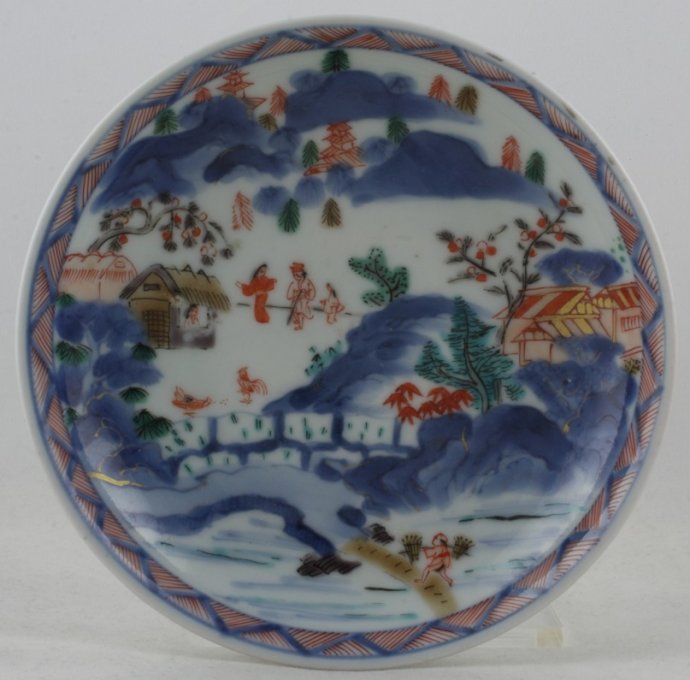
Saucer
Japan
1700-1720
Height 25 mm (0.98 inch), diameter of rim 122 mm (4.80 inch), diameter of footring 59 mm (2.32 inch), weight 92 grams (3.25 ounce (oz.))
Saucer on footring, straight rim with a slightly everted edge. Imari decorated in underglaze blue, iron-red, black, gold and various other overglaze enamels, with in the foreground a spit of land with a man on a bridge, rocks at right, trees and a pavilion. To the left of this chickens behind a fence, three standing figures and another figure in a small house. In the background hills with a pagoda and a pavilion. On the rim a zig-zag lines-pattern border and on the reverse three groups of flower sprays.
The design on this Japanese saucer was taken as an example to be used on a Dutch over-decorated dish in the Jan Menze van Diepen collection (JMVD-P-1037). On this dish the Dutch artist did his best to recreate a Chinese scene, incorporating many elements of Oriental porcelain. These include the motif of the man with a carry-pole on his shoulder, the composition of the landscape, the out-of-perspective pavilion at right and the way the spit of land is depicted. Moreover, some elements of the original were not well understood, such as the rocks at the right, which look more like clouds. The painter combined all these elements in a Western way, thereby creating a Chinoiserie. (Jörg 2002/2, p.156, cat. 109)
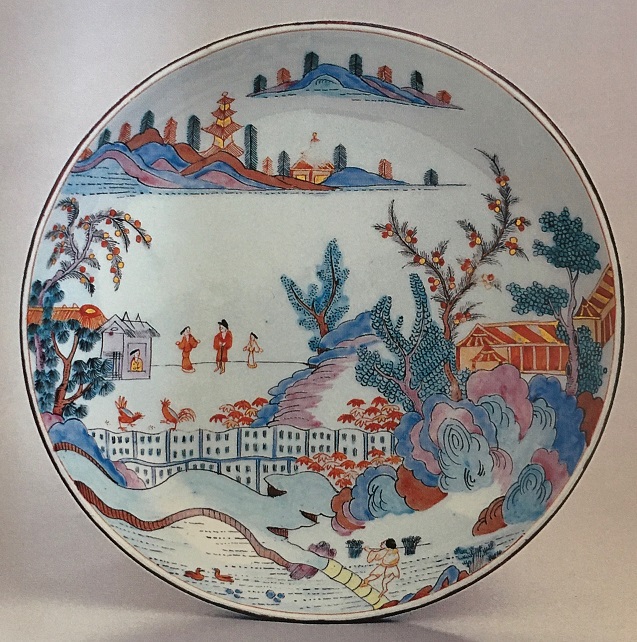
(Dish reproduced from: Jan Menze van Diepen Stichting. Selectie uit de collectie Oosterse keramiek. (Jan Menze van Diepen Foundation. A Selection from the Collection of Oriental Ceramics), (C.J.A. Jörg, Slochteren, 2002), p.156, cat. 109 this dish is not included in this sale/offer)
The decorative style on this saucer is very similar to that used on other, earlier sold, Japanese Imari tea ware. The translucent enamel colours, the zig-zag lines-pattern borders and the reverses with the three widespread flower sprays are all very similar. This could indicate that these may be the product of a single workshop but may or may not be the product of a single kiln, specialised in these high-quality tea wares. Judging by Dutch 18th century sales and inventories, Japanese porcelain was quite expensive at the time and even more highly valued than its Chinese counterpart.
For, earlier sold, Japanese tea wares decorated in this similar style, please see:
- Sold Ceramics - Sold Japanese Tea, Coffee and Chocolate wares 18th Century - Page 1 - Objects 2010334 and 2011366.
-
Sold Ceramics - Sold Japanese wares with Western Designs 1653-1800 - Object 2012088.
-
Sold Ceramics - Sold Japanese wares with Western Designs 1653-1800 - Object 2010609.
Condition: A filled hole in the centre.
References:
Jan Menze van Diepen Collection of Oriental Ceramcis object: JMVD-P-1037
Price: Sold.
Sold Ceramics - Sold Japanese Tea, Coffee and Chocolate wares 18th Century - Page 4
Object 2012663 & 2012664
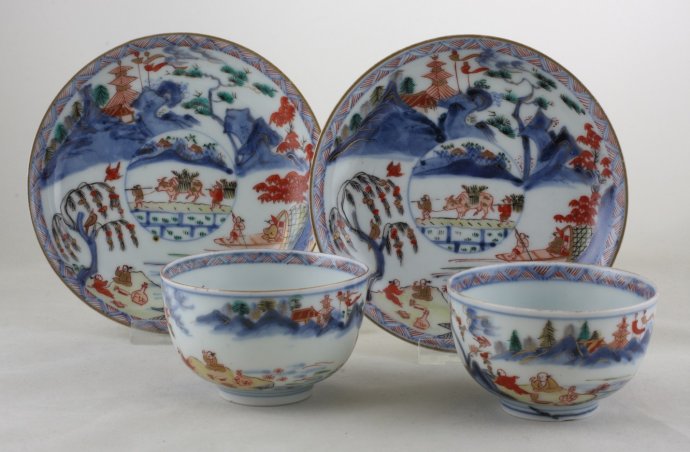
Two tea bowls and saucers
Japan
1700-1720
2012663
Saucer: Height 22 mm (0.86 inch), diameter of rim 130 mm (5.12 inch), diameter of footring 72 mm (2.83 inch), weight 90 grams (3.17 ounce (oz.))
Tea bowl: Height 43 mm (1.69 inch), diameter of rim 77 mm (3.03 inch), diameter of footring 34 mm (1.34 inch), weight 58 grams (2.05 ounce (oz.))
2012664
Saucer: Height 23 mm (0.91 inch), diameter of rim 129 mm (5.08 inch), diameter of footring 70 mm (2.76 inch), weight 98 grams (3.46 ounce (oz.))
Tea bowl: Height 50 mm (1.97 inch), diameter of rim 75 mm (2.95 inch), diameter of footring 32 mm (1.26 inch), weight 53 grams (1.87 ounce (oz.))
Two tea bowls and saucers on footrings, straight rims. Imari, decorated in underglaze blue, iron-red, black, gold and various other translucent enamel colours with two farmers walking with a leashed water buffalo near a rice field with hills, trees and houses in the background in a central roundel surrounded by a riverscape with mountains, pagodas, houses, flags, clouds and pine trees. Two fishermen sit in a boat on a river and on a rocky riverbank two figures are having a pick nick, besides them on the ground stands a cup and saucer on a footring, a rectangular box with chop sticks and a clearly recognisable bottle with the initials 'FW'. Around the rim a zig-zag lines pattern border. On the reverse three widespread flower sprays. The tea bowls are decorated en suite.
In 'Fine & Curious' an identically decorated saucer is published. On this saucer we see the same scene with the same two fisherman having a pick nick on a rocky riverbank with besides them on the ground a teacup on a footring, a rectangular box with chop sticks and a clearly recognisable bottle with the initials 'FW'. Jörg states that the initials 'FW' could very well indicate the owner or the contents, for example Franse Wijn (French wine). In this context it is interesting to note that parts of an export teaset are known that have an Imari decoration of a scene of two Japanese pick nicking on a rocky riverbank under a tree. The bottle with the initials 'FW' is clearly recognisable. European objects were greatly desired in Japan and such inscribed bottles, regarded as exotic Western objects, may not only have been made for Dutch clients, but also for the domestic market. It is tempting to imagine that they were used for sake instead of wine. (Jörg 2003/1, p.221, cat. 276a)
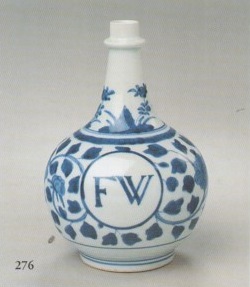
In his Fine & Curious on page 221, cat. 276 Jörg shows this identically shaped and FW initialled bottle Reproduced from: Fine & Curious. Japanese Export Porcelain in Dutch Collections, (C.J.A. Jörg, Hotei Publishing, Amsterdam, 2003), p.100, cat. 99. This bottle is not included in this sale/offer. (copyright in bibliographic data and images is held by the publisher or by their respective licensors: all rights reserved)
A saucer with a similar decoration is known in the Musée Ariana in Geneva. On Japanese porcelain it is already very rare to see an image of a identifiable type of export porcelain, but the image of such a specific object (the bottle with FW initials) is unique. The scene is traditional and does not refer to the Dutch, Decima or the Dutch East India Company (VOC). The two pick nicking figures are Japanese dressed, so it could be obvious that they drink sake (rice wine), so the bottle is in use as a sake bottle. It could very well be that this scene gives a representation of the habits in use in Japan at that time. Upper class people in Japan have always been interested in exotic ceramics, and it can be read in VOC documents that Delfts Faience and German stone good were given as presents to high officials in Nagasaki and Edo. In that interest fits the use of a Western object like the bottle. Remains the question, are the initials a coincidence or were they ordered? Did the porcelain painter have a 'FW' bottle as an example which he copied as an exotic object or was there a tea service ordered by a Dutchman, for example for the person who also ordered the original 'FW' bottles? This seems not to be very likely because the commande element is so low prominent something not very likely to fit in that time. It is however so that bottles like this were used by Japanese and Europeans to contain alcoholic beverages. (Jörg 1989/1, pp. 396-407)
For identically shaped, sized and decorated tea bowl and saucers in the Ashmolean Museum, Oxford, please see:
Condition:
2012663: A firing flaw to the footring of the tea bowl.
2012664: A firing flaw to the footring of the tea bowl.
References:
Price: Sold.
 create websites