

Recent Acquisitions
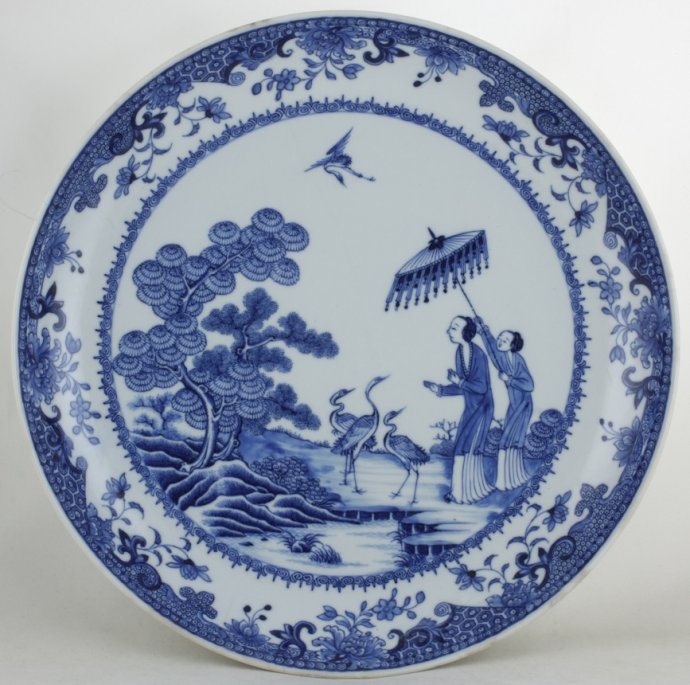
Chine de commande - Western Subjects 1680-1800 - Western Designers - Pronk, Cornelis (1691-1759)
Object 2012722
Dish
China
c.1750
Height 44 mm (1.73 inch), diameter of rim 279 mm (10.98 inch), diameter of footring 166 mm (6.54 inch), weight 672 grams (13.70 ounce (oz.))
Dish on footring, straight rim. Decorated in underglaze blue with a scene reminiscent of Pronk's 'Parasol Lady' design, with a lady standing in a garden near a waterfront gesturing at three cranes in front of her and one in flight while her attendant is holding a tasselled parasol. Various plants and trees are growing near the waterfront. the central scene is outlined by a spiralling border. On the sides flower sprays hanging down from a honeycomb diaper-pattern border. The reverse is undecorated.
Imitations of Pronk Porcelain
For the Dutch East India Company, (Vereenigde Oost-Indische Compagnie, VOC) porcelain made to order after the drawings by Cornelis Pronk proved not to be profitable enough. Private traders however, saw how well it sold, which prompted them to commission simplified versions. This was the beginning of the production of all sorts of blue and coloured versions of this ware, among others of tea ware and of plates. Quite extraordinary were the Japanese imitations of Pronk Porcelain, which featured Japanese geishas instead of the well-known Chinese parasol ladies. This variant was later in turn copied in China as well. After it arrived in the Netherlands, blue Chinese porcelain was occasionally over-decorated in enamel colours (Amsterdams Bont), whereby the Pronk motif was copied as well. English imitations were seen far into the 19th century, while this motif even appears to have still been applied on Maastricht ware of as late approximately 1900. (Source: Groninger Museum)
The design on this dish is an excellent example of an interpretation of Pronk's 'Parasol Lady' design by the Chinese porcelain painters themselves, maybe meant for the own domestic market as an exotic item, an 'Europeanerie'. In this case the waterbirds beside marsh grasses have been replaced by pheasants, while the insects on the reverse have been deleted. Furthermore, the design was also widely copied in Europe, for example by the Venetian Porcelain Factory Cozzi, the Dutch Ouder-Amstel Porcelain Factory and Delft factories. At Delft, there were plain white objects decorated with the Chinese version of the Parasol Ladies. Until the mid to late 19th century the pattern of the 'Parasol Lady' was still used on European porcelain, for example at the famous Herendt Factory in Hungary and at the Porcelain Factory of Maastricht, the Netherlands.
Condition: Restored.
Reference:
Price: Sold.
 create websites