

Chinese Porcelain
Chine de commande
Western Subjects 1680-1800
Page 1
Chinese porcelain with a shape and/or decoration copied directly from a European model is called 'Chine de commande'. It is a special group within the much wider assortment of Chinese export porcelain. There are different varieties: the Western shape with a Chinese decoration, the Chinese shape with a Western decoration, and the Western shape with a Western decoration. Such shapes often are derived from models brought from Europe. The Chinese porcelain painter also copied the Western decorations as best as he could, mostly using European prints as his model. There is an enormous variety of designs of this type: scenes from classical mythology, historical and political events, landscapes with a view of a village or town, amorous or erotic depictions, portraits, religious scenes, etc. A specific type, 'encre de Chine', with its thin, almost drawn lines of grey-black enamel, was best suited to imitate the lines of Western engravings. The designs for commande made by the Dutch artist Cornelis Pronk, in particular the so-called 'Parasol Lady', ordered in three different colour schemes are particularly famous. The VOC (Dutch East India Company, 1602–1799) ordered these between 1735 and 1740 as an expensive exception to the variety of ordinary porcelain that the Company normally bought. Commande was popular throughout the 18th century. Decorations in underglaze blue were painted in the factory; those in enamels were done in muffle kilns in Canton, especially after c.1740.
Chine de comande - Western Subjects 1680-1800
Chine de comande - Western Subjects 1680-1800 decorated objects are, if available, categorized in the following alphabetical order:
- Mythological and Religious Subjects
- Various Subjects
Mythological and Religious Subjects
- Mythological Subjects

Chine de commande - Western Subjects 1680-1800 - Mythological and Religious Subjects - Mythological Subjects - Page 1
Object 2010884
Milk jug
China
1740-1750
Height 103 mm (4.05 inch), diameter 73 mm (2.87 inch), diameter of rim 35 mm (1.38 inch), diameter of footring 40 mm (1.57 inch), weight 196 grams (6.91 ounce (oz.))
Milk jug on footring, pear shaped body with handle, small triangular spout at the rim. The handle is placed opposite the spout. Rim unglazed inside for cover, now missing. Decorated in encre de Chine, iron-red, gold and a pink gold wash with a mythological scene. The winged Cupid holds a crimson heart before the goddess's Venus eyes, while she, with garlands in her lap, reaches down to folds of the gown about her knee. (Howard & Ayers 1978, pp. 330-331)
This scene was most likely taken loosely from the same original, probably an European print of which the original has not been identified as a Meissen porcelain painted with "Venus and Cupid". In the British Museum is just such a bowl painted in the workshop of J.F. Metzsch of Bayreuth where a similar Cupid is on the right of Venus and a domed building behind her. (Howard & Ayers 1978, vol. 1, pp. 330-331)
Although occasionally identified as Venus and Cupid, the iconography suggests that the two figures are Flora and Zephyr. Wearing a décolleté dress and a blossom in her hair, the goddess of flowers clasps a garland as the winged god of the west wind leans toward her with a single flower in his hand. A popular subject with erotic appeal that is much depicted in Western art, the scene is reminiscent of the courtesans whose excesses were part of the Floralia-a Roman springtime festival. The version shown here could be after an engraving by Benoit Audran ! (1661-1721 copying Antoine Coypel (1661-1722). (Litzenburg 2003, p.191)
For an identically decorated teacup, please see:
For similarly decorated objects, please see:
- China for the West. Chinese Porcelain and other Decorative Arts for Export illustrated from the Mottahedeh Collection, (D.S. Howard & J. Ayers, Philip Wilson Publishers for Sotheby Parke Bernet Publications, London 1978), vol. 1, pp.330-331, cat. 326
- La porcelaine des Compagnies des Indes a décor Occidental, (F. & N. Hervouët & Y. Bruneau, Flammarion - Pere Castor, Paris 1986), p.306, cat. 13.58.
-
Chine de commande - Western Subjects 1680-1800 - Mythological and Religious Subjects -
Condition: Two hairlines to the rim.
References:
Howard & Ayers 1978, vol.1, cat. 326
Price: € 599 Currency Converter

Chine de commande - Western Subjects 1680-1800 - Mythological and Religious Subjects - Mythological Subjects - Page 1
Object 2010821
Teacup
China
1740-1745
Height 40 mm (1.58 inch), diameter of rim 75 mm (2.95 inch), diameter of footring 35 mm (1.38 inch), weight 40 grams (1.41 ounce (oz.))
Teacup on footring. Polychrome decorated in various overglaze enamels with a mythological scene. The winged Cupid holds a crimson heart before the goddess's Venus eyes, while she, with garlands in her lap, reaches down to folds of the gown about her knee. On the bottom a single flower spray. (Howard & Ayers 1978, vol. 1, pp. 330-331)
This scene was most likely taken loosely from the same original, probably an European print of which the original has not been identified as a Meissen porcelain painted with 'Venus and Cupid'. In the British Museum is just such a bowl painted in the workshop of J.F. Metzsch of Bayreuth where a similar Cupid is on the right of Venus and a domed building behind her. (Howard & Ayers 1978, vol. 1, pp. 330-331)
Although occasionally identified as Venus and Cupid, the iconography suggests that the two figures are Flora and Zephyr. Wearing a décolleté dress and a blossom in her hair, the goddess of flowers clasps a garland as the winged god of the west wind leans toward her with a single flower in his hand. A popular subject with erotic appeal that is much depicted in Western art, the scene is reminiscent of the courtesans whose excesses were part of the Floralia-a Roman springtime festival. (Litzenburg 2003, p.191)
An identically decorated milk jug was sold at:
For similarly decorated objects, please see:
- China for the West. Chinese Porcelain and other Decorative Arts for Export illustrated from the Mottahedeh Collection, (D.S. Howard & J. Ayers, Philip Wilson Publishers for Sotheby Parke Bernet Publications, London 1978), vol. 1, pp.330-331, cat. 326
- La porcelaine des Compagnies des Indes a décor Occidental, (F. & N. Hervouët & Y. Bruneau, Flammarion - Pere Castor, Paris 1986), p.306, cat. 13.58.
- Chinese Export Porcelain in the Reeves Center Collection at Washington and Lee University, (Th. V. Litzenburg, London 2003), p.191, cat. 190.
-
Chine de commande - Western Subjects 1680-1800 - Mythological and Religious Subjects -
Condition: A hairline with a restored frit to the rim.
References:
Howard & Ayers 1978, vol.1, cat. 326
Price: € 499 Currency Converter
Mythological and Religious Subjects
- Religious Subjects
Currently there are no Chine de commande - Western Subjects 1680-1800 - Mythological and Religious Subjects - Religious Subjects objects for sale.
Various Subjects
Various Subjects decorated objects are, if available, categorized in the following alphabetical order:
- Amorous
- Couples
- Hunting Scenes
- Indoor Scenes
- Meissen Style
- Outdoor Scenes
- Various
Various Subjects
- Amorous

Chine de commande - Western Subjects 1680-1800 - Various Subjects - Amorous - Page 1
Object 2011987
Milk jug
China
1740-1760
Height with cover 131 mm (5.16 inch), height without cover 106 mm (4.17 inch), diameter handle to spout 104 mm (4.09 inch), diameter of mouthrim 40 mm (1.57 inch), diameter of footring 40 mm (1.57 inch), weight including cover 213 grams (8.15 ounce (oz.)), weight cover 31 grams (1.09 ounce (oz.))
Milk jug on footring, pear shaped body with handle, small triangular spout at the rim. The C-shaped handle is placed opposite the spout. Matching cover with pointed knob. Decorated in various overglaze enamels and gold with the 'The Valentine' or 'Alter of Love' pattern, a landscape scene with two love birds bill affectionately as they perch on Cupid's quiver while his bow lies nearby in the front an altar with two flaming hearts,the scene is flanked by a pine or breadfruit tree and garlanded curtains. Round the rim a scroll-and-shell border. The cover is decorated en suite.
According to Motley this is a well known pattern found on a small range of Chinese export pieces. The origins are not clear but it seems to have been done for Lord Anson in 1743 and is based on a drawing by Sir Piercy Brett (c.1710-1781) who was Lieutenant on Anson's flagship HMS Centurion on his voyage round the world. (1740-1744) Anson made Brett captain of the Centurion while they were in Canton, 30 Sept 1743, and he did many drawings of the voyage. The earliest version of this pattern has a breadfruit tree and a palm tree then appear in the centre of an export armorial dinner service with the arms of Anson. In this service the tree has garlands of flowers and many of the elements of this pattern are present: the flaming hearts on the altar, the dog, the shepherd's crook, the birds, the bow and arrows. Sometimes drawn back curtains are added which are very suggestive of an erotic voyeurism, resembling the drapes of a four poster bed. Such use of suggestive array was popular for an eighteenth century audience and would have been readily comprehensible to an educated eighteenth century eye. The use of pastoral imagery and symbolism as code for amorous activities was ubiquitous then. The Valentine design appears on its own in a number of English ceramic wares of the eighteenth century and it was used on Chinese export porcelain, armorial and pseudo-armorial objects as well. (Motley 2014)
Howard states that the idea for the Valentine pattern, by Piercy Brett, was certainly inspired by Anson and Piercy's stay on Tenian Island to collect breadfruit trees for the British West Indian colonies. An illustration in Anson's Voyages shows a very similar breadfruit tree an palm while other allusions are to absent loved ones. The Valentine pattern had a popularity which saw it produced in underglaze blue with hounds and puppies and with Chinese-looking shepherds in European clothes seated beneath pine trees. It was copied at Worcester and elements appear on Chinese snuffbottles and rim cartouches for a decade after the Anson's service. It became in fact part of the repertoire of Chinese workshops in Canton. (Howard 1994)
The Valentine design remained long in vogue; for in 1778 we still find it described as 'a burning altar, and two small doves on a quiver with a bow, and accessories' in the catalogue of a sale held in that year at Amsterdam of the stock of the porcelain-shop of Martha Raap. (Lunsingh Scheurleer 1974, p.158)
For identically, polychrome decorated objects, please see:
- China trade porcelain. An account of its historical background, manufacture, and decoration and a study of the Helena Woolworth McCann Collection, (J. Goldsmith Phillips, Harvard University Press, Cambridge, Massachusetts, 1956). p.152, Plate 67.
- China for the West. Chinese Porcelain and other Decorative Arts for Export illustrated from the Mottahedeh Collection, (D.S. Howard & J. Ayers, Philip Wilson Publishers for Sotheby Parke Bernet Publications, London 1978), vol. 1, pp.205-206, cat. 204 & vol. 2, p.364, cat. 355.
For similarly decorated objects, please see:
- Porcelaine de le Compagnie des Indes, (M. Beurdeley, Office du Livre, Fribourg, 1962), p.178, cat. 109.
- Chinese export porcelain. Chine de Commande, (D.F. Lunsingh Scheurleer, London, 1974), English translation of the Dutch edition, Hilversum 1966, cat. 295.
- La porcelaine des Compagnies des Indes a décor Occidental, (F. & N. Hervouët & Y. Bruneau, Flammarion - Pere Castor, Paris 1986), p.182, cat. 7.118 & 7.119.
- Ostindisk Porselen i Norge (J. Huitfeldt, Huitfeldt Forlag A.S., Oslo, 1993), p.57 & pp.110-111.
- The Choice of the Private Trader. The Private Market in Chinese Export Porcelain illustrated from the Hodroff Collection, (D.S. Howard, Zwemmer, London, 1994), pp.89-91, cat. 77-80.
- Chinese Export Porcelain in the Reeves Center Collection at Washington and Lee University, (Th. V. Litzenburg, London 2003), p.163, cat. 158.
- Chinese Export Ceramics, (R. Kerr & L. Mengoni with a contribution by Ming Wilson, V&A Publishing, London 2011), pp.65-66 & p.135, nt. 12.
Condition: Some popped bubbles of glaze to the tip of the spout and a chip with some frits and fleabites to the rim of the cover. A shallow frit to the footring.
References:
Goldsmith Phillips 1956, p.146 & plate 67
Lunsingh Scheurleer 1974, p.158 & cat. 295
Howard & Ayers 1978, vol. 1, cat. 204, & vol. 2, cat. 355
Hervouët 1986, cat. 7.118 & 7.119
Huitfeldt 1993, p.57 & pp.110-111
Kerr 2011, pp.65-66 & p.135, nt. 12
Price: € 1.249 Currency Converter

Chine de commande - Western Subjects 1680-1800 - Various Subjects - Amorous - Page 1
Object 2011831
Teacup
China
1745-1750
Height 39 mm (1.53 inch), diameter of rim 74 mm (2.91 inch), diameter of footring 31 mm (1.22 inch), weight 35 grams (1.23 ounce (oz.))
Teacup on footring, slightly everted rim. Decorated in encre de Chine, green enamel and gold with a seated young woman with a monkey on her lap. She is dressing him up like a doll. On the rim a border of panels edged in strapwork, floral festoons and foliate-scrolls after an early 18th century laub- und bandelwerk Viennese design. Round the inside rim a single concentric band.
On the, now missing, matching saucer the paw of the animal rests on a small shelf to which it is connected by a long chain, this detail is not portrayed on the teacup probably due to its size.
In 1722 Père d'Entrecolles reported that the Chinese were experimenting with painting in black, so far unsuccessfully. Black or schwarzlot, decoration, was also then just being developed in Europe, and in fact the German Hausmaler was putting it primarily on Chinese imported in the white, rather than on wares from the newly established Meissen factory. It must have been these hybrids that were sent back to Canton for imitation at the time of Père d'Entrecolle's letter, but the perfection of the technique and its translation into commercial export porcelain came only later, under the direct influence of the Du Paquier period (1719-1744). Encre de Chine lent itself perfectly to the copying of Western engravings in thin, black lines. (Jörg & Van Campen 1997, p. 273)
Unique to the Viennese Du Paquier porcelain factory was the laub- und bandelwerk border, based on two series of engravings by Paul Decker (d.1713). Continually modified and varied its essential elements were strapwork, palmettes, trelliswork cartouches, and foliate scrolls combined into a rhythmical pattern of baroque formality. Other China trade versions of the laub- und bandelwerk border, such as the more usual one with the addition of peacock and with panels of quilting rather than trellis- or scale work, are farther removed from their Viennese factory prototypes, and are perhaps derived from Hausmaler variants. (Corbeiller 1974, pp.68-69)
In European iconography the monkey is a symbol of sexual desire and lust. This decoration therefore had an explicit erotic connotation and in all likelihood an amorous meaning for those who used the tea set. The source of this design which is very rare on Chine de commande, is still unknown. (Jörg 1989/2, p.213)
For an identically in encre de Chine, green enamel and gold decorated coffee cup and saucer, please see:
For a similarly in encre de Chine, green enamel and gold decorated saucer with a similarly border design, please see:
For a similarly in encre de Chine and various enamels decorated jug, please see:
For other Chine de commande decorated objects using monkeys for an explicit erotic connotation, please see:
- La porcelaine des Compagnies des Indes a décor Occidental, (F. & N. Hervouët & Y. Bruneau, Flammarion - Pere Castor, Paris 1986), pp.136-137, cat. 6.63.
- Chinese Export Porcelain. Chine de Commande from the Royal Museum of Art and History in Brussels, exhibition catalogue Hong Kong Museum of Art, (C.J.A. Jörg, The Urban Council, Hong Kong, 1989), pp.196-197, cat 74.
- Sold Ceramics - Sold Chine de commande - Western Subjects 1680-1800 - Various Subjects - Amorous - Object 2010275.
Condition: A firing flaw to the rim and three firing flaws to the inner wall.
References:
Lunsingh Scheurleer 1980, Abb. 201.
Hervouët 1986, cat. 6.63 & 6.64
Jörg & Van Campen 1997, p. 273
Price: € 1.249 Currency Converter
Various Subjects
- Couples

Chine de commande - Western Subjects 1680-1800 - Various Subjects - Couples - Page 1
Object 2012414
Teapot
China
c.1745
Height with cover 135 mm (5.31 inch), height without cover 95 mm (3.74 inch), diameter handle to spout 200 mm (7.87 inch), diameter of mouthrim 62 mm (2.44 inch), diameter of footring 52 mm (2.05 inch), weight including cover 470 grams (16.58 ounce (oz.)), weight cover 89 grams (3.14 ounce (oz.))
Teapot of globular shape on footring. Straight spout with a curved C-shaped handle. Domed pierced cover and pointed knob. Decorated in iron-red, encre de Chine and gold after an unknown source, showing a European couple seated on the trunk of a tree in a garden landscape flanked by a boy appearing from the bushes behind and a running dog. The cover is decorated with a running dog under a tree.
The source of this romantic scene is not known, but it may have been derived from a European engraving / print.
For a similarly decorated saucer, please see:
Condition: A professionally restored tip of the knob and a sealed hairline from one side, through the bottom, to the other side.
Reference:
Price: € 599 Currency Converter
Currently there are no Chine de commande - Western Subjects 1680-1800 - Various Subjects - Couples objects for sale.
Various Subjects
- Hunting Scenes
Currently there are no Chine de commande - Western Subjects 1680-1800 - Various Subjects - Hunting Scenes for sale.
Various Subjects
- Indoor Scenes

Chine de commande - Western Subjects 1680-1800 - Various Subjects - Indoor Scenes - Page 1
Object 2011914
Saucer
China
c.1735
Height 17 mm (0.67 inch), diameter of rim 118 mm (4.65 inch), diameter of footring 69 mm (2.72 inch), weight 46 grams (1.62 ounce (oz.))
Saucer on footring with straight sides and a slightly spreading rim. Decorated in encre de Chine and gold with two European figures wearing Oriental clothes in an Oriental interior with a door. One figure is standing wearing an elaborate robe holding a sprig of coral, the other with a dog on a leash beside a large vase decorated with a monster head (t'au-t'ie). The vase is filled with a sprig of coral, sprays of fungus and peacock feathers. Beside to the vase a wine pot and a pure depiction of an ancient bronze 'Hu', a water jug. On the inside rim a leafy scroll border reserved with flower heads.
Much of the Chine de commande made in the second quarter of the 18th century is decorated in encre de Chine, a grey-black enamel that could be thinly applied and which lent itself to copies of Western engravings and etchings. It is not ink as the French term implies, as ink burns during firing. (Jörg 2002/2, p.149)
This scene is interesting because the Chinese painter choose to portrait these two European figures in the symbolism of his own country by placing two large peacock feathers, two coral branches and two fungi in a large vase, the first being a symbol of high rank, the other two stand for longevity. (Lunsingh Scheurleer 1974, p. 222)
Spruit states that in her opinion the figures depicted in this scene are "tribute carriers", figures carrying something precious on their way to present the objects to the Emperor and by doing so acknowledging his power. In a museum in Taiwan there is a painting on silk by Yen Li-pên (618-907) on which we can see local rulers with their servants on their way to bring grace to the Emperor. These figures are depicted with exotic hair, clothes and precious objects such as coral, animals and plants. The barefoot servants who carry the objects wear the same slave wrist collars as our little boy (also barefoot). The he-goat is similarly spotted as the dog. Perhaps we can state that Yen Li-pên's painting on silk and this 18th-century decoration are two testimonials of a familiar motif, because they were the "tribute carriers", surely for the 18th-century porcelain decorators. So it seems very likely that the nameless porcelain decorator who decorated this teacup somewhere in a Canton workshop during the mid 18th-century, depicted an image that he could relate to, most likely from images he had seen on prints or in books of 18th-century Chinese "tribute carriers". (Spruit 1967, pp.179-183)
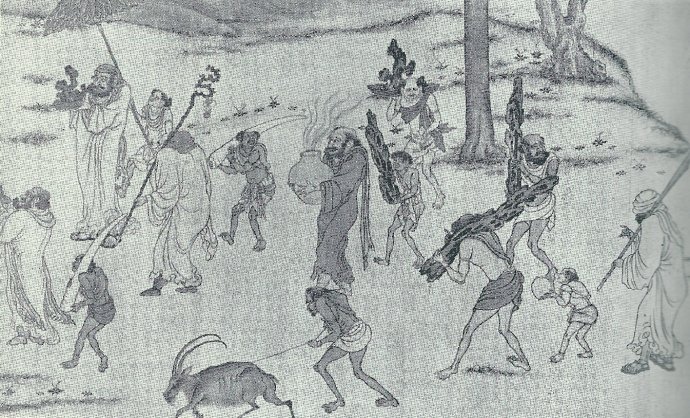
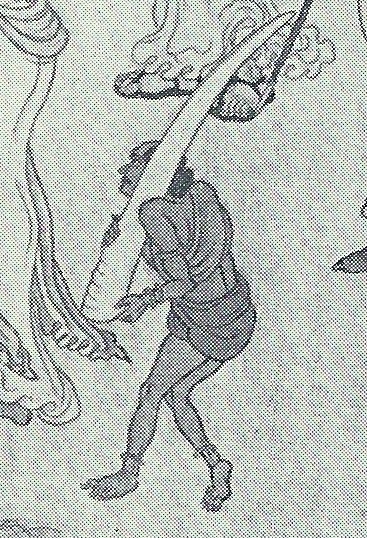
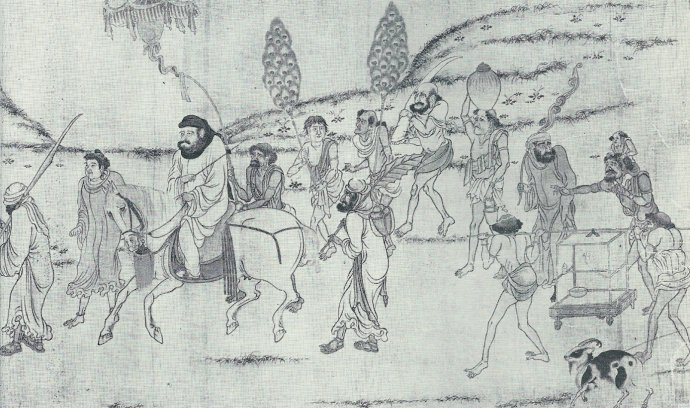
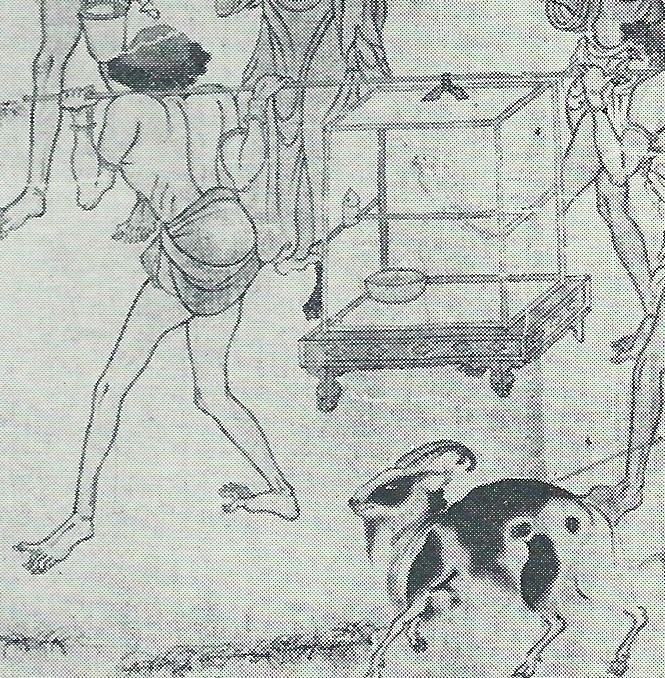
Painting Yen Li-pên
Reproduced from: "Een decor in encre de Chine", L. Spruit in; ANTIEK, II-4, November 1967, pp. 179-183, Chinese Export Porcelain. Chine de Commande, (D.F. Lunsingh Scheurleer, Faber and Faber Limited, London, 1974), p.222, cat. 222.
For, previously sold, identically decorated objects, please see:
For identically decorated objects, in encre de Chine or polychrome, please see:
- "Een decor in encre de Chine", L. Spruit in; ANTIEK, II-4, November 1967, pp. 179-183.
- Chinese Export Porcelain. Chine de Commande, (D.F. Lunsingh Scheurleer, Faber and Faber Limited, London, 1974), p.222, cat. 222
- La porcelaine des Compagnies des Indes a décor Occidental, (F. & N. Hervouët & Y. Bruneau, Flammarion - Pere Castor, Paris 1986), p.113, cat. 5.8.
Condition: A fleabite with a short connected hairline to the rim.
References:
Lunsingh Scheurleer 1966, cat. 213
Lunsingh Scheurleer 1974, cat. 222
Price: € 749 Currency Converter

Chine de commande - Western Subjects 1680-1800 - Various Subjects - Indoor Scenes - Page 1
Object 2011224
Coffee cup
China
1750-1760
Height 65 mm (2.56 inch), diameter of rim 58 mm (2.28 inch), diameter of footring 27 mm (1.06 inch), weight 82 grams (2.89 ounce (oz.))
Coffee cup with handle on footring. Decorated in encre de Chine, iron-red and gold with a woman wearing a half-opened nightdress revealing her breasts, hands, buttocks and legs, clipping her toenails while being watched by a servant. in an oval shaped medallion, round the rim a stylised spear-head-pattern border.
The decoration on this coffee cup had an explicit erotic connotation for those who used the coffee / tea set. The source of this design on Chine de commande, is still unknown. A very similar design of a naked lady seated in a chair extending her foot towards a tub into which a boy empties a pitcher is, according to Hervouët, after a print by Duflos entitled 'The Bath'. (Jörg 1989/2, p.218)
Perhaps the 'The Bath' design was made by Duflos as one of a series and the design on this coffee cup was made after another, yet unknown, print from this series.
For identically decorated objects, please see:
- Chinese ceramiek, catalogue Haags Gemeentemuseum, (B. Jansen, De Tijdstroom, Lochem, 1976), p.144, cat. 339.
- La porcelaine des Compagnies des Indes a décor Occidental, (F. & N. Hervouët & Y. Bruneau, Flammarion - Pere Castor, Paris 1986), p.127, cat. 6.38.
Condition: A restored chip with a connected (sealed) hairline to the rim.
References:
Price: € 399 Currency Converter
Various Subjects
- Meissen Style
The maritime commerce scenes on the original Meissen ware were often copied from etchings after Johann Wilhelm Baur (16078-1640). Chinoiseries predominated from quite early on at the Meissen Manufactory, but from about 1730 there was a shift to depicting European settings. (Emden 21015/1, p.101)

Chine de commande - Western Subjects 1680-1800 - Various Subjects - Meissen Style - Page 1
Object 2011704E
Saucer
China
1750-1775
Height 24 mm (0.95 inch), diameter of rim 121 mm (4.76 inch), diameter of footring 71 mm (2.80 inch), weight 78 grams (2.75 ounce (oz.)
Saucer on footring, spreading sides and rim. Decorated in various overglaze enamels, and gold after the style of Meissen porcelain with a European harbour with a large fortress, mountains houses, boats with fisherman and trees. On the quay two men hunting for ducks. On the sides and rim a decorative pattern of scrollwork. The reverse is undecorated.
Chine de commande
This French expression is used for Chinese porcelain, of which the shape and mainly the decorations are derived from Western examples. Decorations, often European prints (engravings) were cheap and easily brought along by ship to Asia. They were then meticulously copied on order in China, at first in blue and white, but very soon (from approximately 1715 onwards) also in enamel colours. This often-involved porcelain featuring family coats of arms – how fancy this looked on a dinner table – though all kinds of other depictions were also popular. Scenes from the Bible and classical antiquity, depictions of ships, harbours, landscapes as well as city views were all quite common too. Slightly erotic scenes were also much favoured. (The World at Home: Asian porcelain and Delft pottery held from 17 June 2017 to 10 March 2019 at the Groninger Museum, The Netherlands)
The design on this saucer is a direct copy from a Meissen original, including the decorative pattern of scrollwork which is typical of Meissen porcelain of the period 1720-1740. The very detailed and refined painting, so faithfully copying the original, illustrates the craftsmanship of the Chinese porcelain painter and the quality that could be reached in export porcelain. However, Chine de commande, like this must have cost a good deal more than the ordinary enamelled wares for export. (Jörg 1989/2, p.226)
For an identically decorated dish, in the collection of the Rijksmuseum Amsterdam please click here.
For an identically decorated dish, please see:
Condition: A glaze firing flaw to the base.
References:
The World at Home: Asian porcelain and Delft pottery held from 17 June 2017 to 10 March 2019 at the Groninger Museum, The Netherlands.
Price: € 349 Currency Converter
More pictures of object 2011704F, another identically shaped, sized and decorated saucer >>
Various Subjects
- Outdoor Scenes

Chine de commande - Western Subjects 1680-1800 - Various Subjects - Outdoor Scenes - Page 1
Object 2012575
Small dish
China
c.1735
Height 34 mm (1.34 inch), diameter of rim 162 mm (6.38 inch), diameter of footring 93 mm (3.66 inch), weight 195 grams (6.88 ounce (oz.))
Small dish on footring, flat rim. Decorated in various overglaze, famille rose enamel, white, green, blue and black enamels, iron-red and gold with two men a garden with a flowwering tree and plants, taihu (garden) rocks and a fence. One man is presenting a bird to the other man seated on the rocks. On the sides and rim a white enamelled bianco sopra bianco flower pattern with flower heads in famille rose enamel. The reverse is undecorated.
To enable Chinese porcelain factories, make objects that were unknown in China at teh time, such as saltshakers and beer mugs, several wooden models were sent to China in 1635. A few years later it was possible to order any desired model.
From the beginning of the 18th century onwards, it was also possible to have objects decorated according to European tastes.
The porcelain produced according to European example, or bearing decorations following Western examples, is referred to as Chine de commande.
Obviously, the Chinese porcelain painter painstakingly copied the scene from a (yet unknown) Western print, possibly an engraving, and evidently this is a commissioned representation. The design is known as the 'birdcatcher'. Both men clearly have European appearances, hair styles and clothing.
For an identically decorated dish, please see:
For another, later (c.1770), variant but similarly decorated dish, please see:
Condition: A restored hairline, frit and chip to the rim.
Reference:
Hervouët 1986, cat. 4.31 & 4.32
Price: Sold.

Chine de commande - Western Subjects 1680-1800 - Various Subjects - Outdoor Scenes - Page 1
Object 2011606
Milk jug
China
c.1755
Height 100 mm (3.94 inch), diameter 72 mm (2.83 inch), diameter of rim 37 mm (1.46 inch), diameter of footring 39 mm (1.54 inch), weight 175 grams (6.17 ounce (oz.))
Milk jug on footring, pear shaped body with handle, small triangular spout at the rim. The handle is placed opposite the spout. Rim unglazed inside for cover, now missing. Decorated in encre de Chine and gold with an elegant fisherman with a fishing net on his shoulder presenting his catch to a seated young woman who is also fishing. On the rim a border of panels edged in strapwork, floral festoons and foliate-scrolls after an early 18th century laub- und bandelwerk Viennese design.
.jpg)
(Engraving reproduced from: www.ghilli.it, this engraving is not included in this sale)
A painting titled L' Acqua' by the Venetian painter Jacopo Amigoni (ca.1682-1752) was the inspiration for an engraving by Joseph Wagner (1706-1780), This scene clearly is based on a version of this engraving. The engraving was part from a set of four 18th century engravings by Jacopo Amiconi, Allegory of the four elements, Water, Air, Earth and Fire engraved in Venice, by Joseph Wagner (1706-1780). The engravings show a gardener presenting a woman with flowers for Earth; a couple removing a bird’s nest from a tree for Air; figures fleeing a burning house for Fire and finally a scene of two anglers for Water, similar to those on this milk jug.
Jacopo Amigoni (ca.1682-1752), a Venetian painter, lived in England between 1729-1739 and attempted to set up a print shop with Joseph Wagner before both returned to Venice. Patronised by Queen Caroline (wife of George II) he is credited with introducing Venetian rococo to British royal portraiture (www.ghilli.it, Hervouët 1986, p.65)
Hervouët states that the design was very successful in the 18th century. Interestingly, this decoration can also be found on earthenware from Marseille. (Hervouët 1986, p.65)
For teapots decorated in encre de Chine with an identical scene, please see:
- The Philadelphia Museum of Art - Accession number 1948-62-107a,b
- La porcelaine des Compagnies des Indes a décor Occidental, (F. & N. Hervouët & Y. Bruneau, Flammarion - Pere Castor, Paris 1986), p.65, cat. 3.6.
Condition: Perfect.
References:
Price: € 749 Currency Converter
 create websites