

News
November 26, 2023
I am proud to announce that today November 23, 2023, I welcomed the 10,000,000th visitor to my website!
May 2023
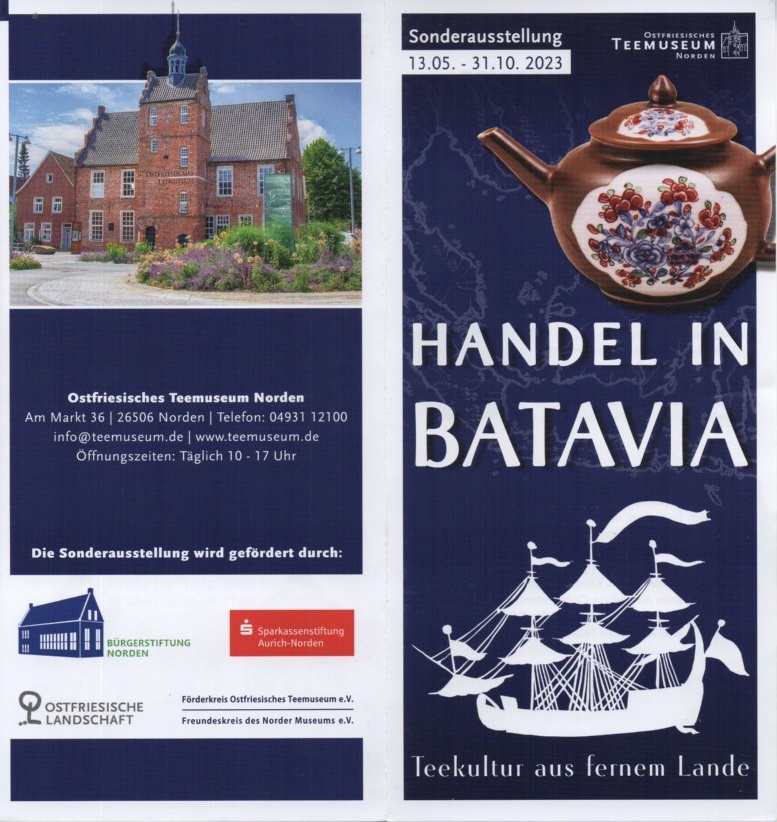
Currently the sold objects 2012533, 2012515 and 2011899 are on display at the exhibition 'Handel in Batavia Teekultur aus fernen Lande / Trade in Batavia Tea Culture from a faraway Land'. Held from 13 May 2023 to 31 October 2023 at the Ostfriesisches Teemuseum Norden, Germany. For more information regarding this exhibition and it's interesting exhibition catalogue, please check the website of the Ostfriesisches Teemuseum Norden.
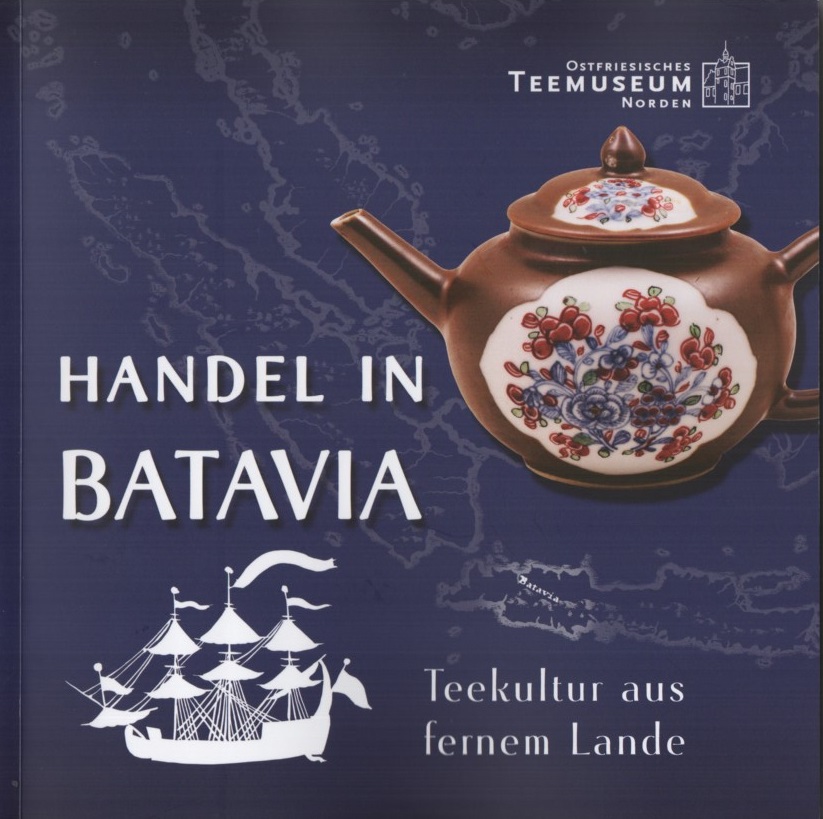
(copyright in bibliographic data and cover images is held by the publisher or by their respective licensors: all rights reserved)
May 20, 2022
I am proud to announce that today May 20, 2023, I welcomed the 9,000,000th visitor to my website!
October 30, 2022
I am proud to announce that today October 30, 2022, I welcomed the 8,000,000th visitor to my website!
February 28, 2022
I am proud to announce that today February 28, 2022, I welcomed the 7,000,000th visitor to my website!
October 2020
I am proud to announce that today October 4, 2020, I welcomed the 6,000,000th visitor to my website!
July 2020
Two new categories named 'Bargain SALE Chinese Porcelain' and 'Bargain SALE Japanese Porcelain' have been created. The categories can be found in the left side menu.
In these categories Chinese and Japanese export porcelain objects for sale are now offered at a significantly reduced price.
If you are interested in a purchase, or want more information on one of the objects, please feel free to contact me at: patergratiaorientalart@hotmail.com.
October 2019
I am proud to announce that today October 29, 2019, I welcomed the 5,000,000th visitor to my website!
February 2019
I am proud to announce that today February 3, 2019, I welcomed the 4,000,000th visitor to my website!
May 2018
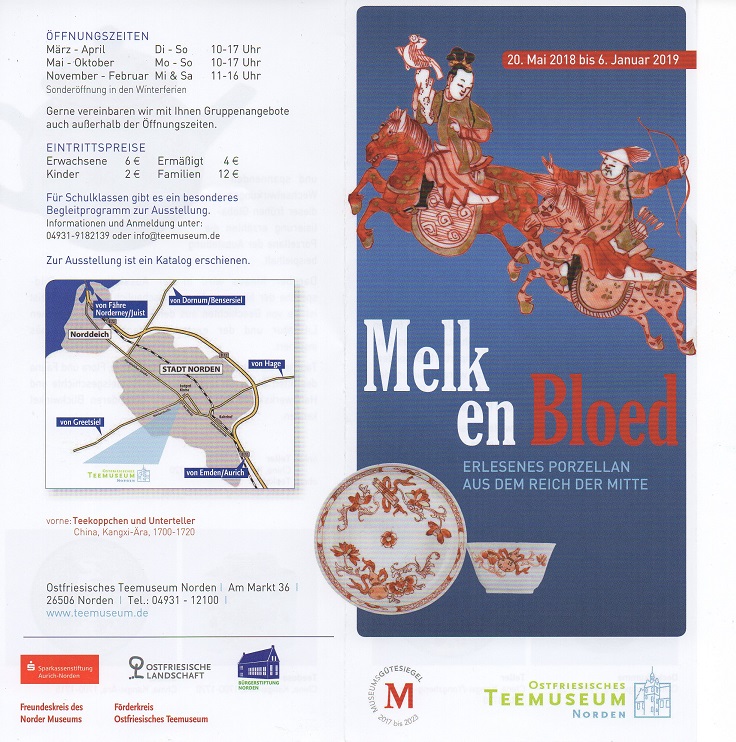
Currently the sold objects 2011513, 2011946 and 2012008 are on display at the exhibition 'Melk en Bloed. Erlesenes Porzellan aus dem Reich der Mitte'. Held from 20 May 2018 to 6 January 2019 at the Ostfriesisches Teemuseum Norden, Germany. For more information regarding this exhibition and it's interesting exhibition catalogue, please check the website of the Ostfriesisches Teemuseum Norden.
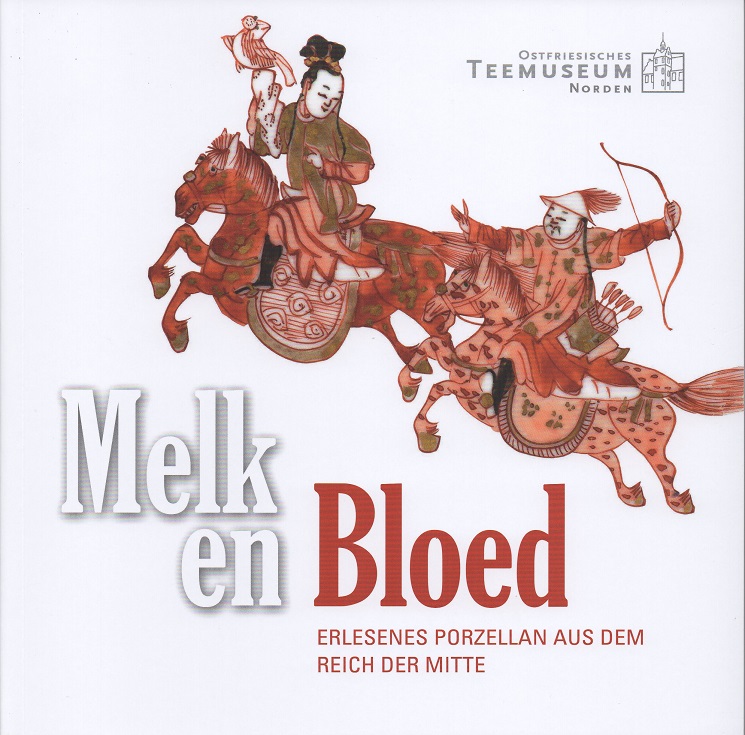
(copyright in bibliographic data and cover images is held by the publisher or by their respective licensors: all rights reserved)
November 2017
I am proud to announce that today November 24, 2017, I welcomed the 3,000,000th visitor to my website!
June 2017
The following sold or donated objects: 2010609, 2011087, 2011269 & 2011270, 2011301, 2011328, 2011329, 2011469, 2011525 & 2011526 are currently on display at the exhibition: The World at Home: Asian porcelain and Delft pottery held from 17 June 2017 to 24 March 2019 at the Groninger Museum, The Netherlands.
In the 17th and 18th centuries, Dutch interiors were enriched by Asian influences. The Dutch East India Company and individuals imported large quantities of Chinese and Japanese porcelain and lacquerwork from “the Orient”. Porcelain, in particular, found its way into every stratum of society: even the poorest household was likely to own a plate or a teacup and saucer from China. Before long, Asian porcelain had become part of Dutch everyday life and material culture. Its popularity soon gave rise to imitations. This exhibition shows how Asian and Dutch producers responded to public interest and buyers’ tastes, and how they competed with each other.
Starck Pavilion - 17 June 2017 to 24 March 2019
Museumeiland 1
9711 ME Groningen
Tel.: 0031 +50 3 666 555

March 2017
The donated object 2011095 is currently on display at the exhibition 'China Character, The Story on Porcelain' held from 31 March to 22 October 2017 at the Gemeentemuseum Den Haag, The Netherlands. For more information regarding this exhibition, please check the website of the Gemeentemuseum Den Haag.

December 2016
The following sold objects: 201034, 2010190, 2010372, 2010612 & 2010406, 2010815, 2010848, 2010856,
2011306, 2011425, 2011441, 2011472, 2011506, 2011608, 2011619, 2011639, 2011701, 2011760 and 2011767 are currently on display at the exhibition The Asian Galleries Reinmagined - Color Across Asia held from 21 December 2016 to 13 May 2018 at the Ackland Art Museum, The University of North Carolina at Chaphil Hill, The United States of America.
Chapel Hill, N.C. — The Ackland Art Museum’s galleries of Asian art have reopened following a ground-breaking reinstallation, the first since August 2011. Collectively called The Asian Galleries Reimagined, the spaces include an unprecedented chromatic arrangement of artworks, as well as rotating themes, with pieces on view ranging from Neolithic burial urns and Chinese Imperial porcelains to contemporary Cambodian art and Japanese Art Deco screens.
"The Asian galleries’ redesign spotlights the Museum’s outstanding collection of art from across the Asian continent, while also elucidating the interconnectedness of the cultures, traditions, and arts of Asia and beyond," said Bradley Bailey, associate curator of Asian art.
The new installations will include a number of important recent acquisitions and rarely seen works. Highlights include Chinese export porcelains donated by Richard S. Pardue, Chinese ceramics given by Smith Freeman, gifts and loans of contemporary Japanese ceramics from Carol and Jeffery Horvitz, and major pieces from benefactors such as the Tyche Foundation, Herbert and Eunice Shatzman, Beatrice Cummings Mayer, and the Rubin Ladd Foundation.
"With this reinstallation, we celebrate our collection’s remarkable legacy and its significance to the University, the Triangle, our state, and the wider art world," said Ackland director Katie Ziglar.
Occupying the larger of the Ackland’s two Asian art galleries, the exhibition Color Across Asia (through 13 May 2018) displays several millennia of art, showcasing a rich history of innovation, invention, and imitation. From the pure white of Chinese kaolin clay to the rich black of Japanese lacquers―and all the colors in between―Ackland visitors will see how pigments, decorative motifs, and glazing techniques made their way from Iranian grand bazaars to Indian temples, Chinese palaces, Japanese teahouses, and beyond.
Color Across Asia has been made possible in part by The Ruth and Sherman Lee Fund for Asian Art and the Lee Family, Philip and Linda Carl, and James Keith Brown and Eric Diefenbach.
For an object guide of the The Asian Galleries Reinmagined - Color Across Asia exhibition please click here, for more information regarding the exhibition, please check the website of the AcklandArtMuseum.
Ackland Art Museum
October 2016
I am proud to announce that today October 6, 2016, I welcomed the 2,000,000th visitor to my website!

January 2016
The sold objects 2011494, 2011495 and 2011499 were on display at the exhibition ' Porzellanschätze der Kangxi-Zeit / Porcelain Treasures of the Kangxi Period' held from 19 july 2015 until 17 January 2016. at the Hetjens Deutches Keramikmuseum, Düsseldorf.
For more information regarding the exhibition and it's interesting exhibition catalogue, please check the website of the Hetjens Deutches Keramikmuseum, Düsseldorf.
The sold objects 2011494, 2011495 and 2011499 can be viewed as catalogue entries 97 & 125 in:
(copyright in bibliographic data and cover images is held by the publisher or by their respective licensors: all rights reserved)

August 2015
I am very proud to announce that just recently I have added the J.M. van Diepen Foundation to my client list.

Jan Menze van Diepen (1905-1994) was born in Waterhuizen to a family of Groningen shipbuilders. He was a versatile and passionate collector who brought together an extensive collection of paintings, prints and Oriental porcelain. Following his death, his unique collection was transferred to the J.M. van Diepen Foundation and is now housed in the Fraeylemaborg an 18th-century country estate in Slochteren, Groningen. Van Diepen's rich collection of c. 2,500 Chinese and Japanese export porcelain objects include many interesting and rare pieces dating from the 15th to the 20th century.
For me the sale to the J.M. van Diepen Foundation was extra special. As a young boy my father took me along on one of his visits to Mr. Van Diepen's private home. I had the privilege of meeting this very friendly gentleman and seeing (part) of his Chinese and Japanese export porcelain collection in person. I could never have imagined than that one day Mr. Van Diepen's Foundation would become a client of my Pater Gratia Oriental Art. For the latest newsletter from the Fraeylemaborg (in Dutch) with a chapter on the latest acquisitions of the Jan Menze van Diepen Foundation, please click here Klik hier om de nieuwsbrief te openen.
In 2002 a selection from the collection, dedicated to export porcelain from China and Japan, was published in the series Selections from the J.M. van Diepen Collection. For this publication please see:
(source: Jörg 2002/2)

April 2015

Currently sold object 2011513 is on display at the exhibition 'Have a Cup of Tea. Chinese Porcelain and Tea in North-West Germany. Held from 22 March to 23 August 2015 at the East Frisia Museum Emden, Germany. For more information regarding this exhibition and it's interesting exhibition catalogue, please check the website of the Ostfriesisches Landesmuseum.


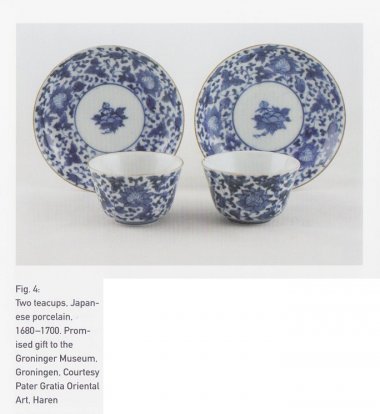
Have a Cup of Tea. Chinese Porcelain and Tea in North-West Germany, (Exhibition catalogue, Isensee Verlag, Oldenburg, 2015), p.14, Fig. 4 / Made in China, Porzellan und Teekultur im Nordwesten, (Exhibition catalogue, Isensee Verlag, Oldenburg, 2015), p.14, Fig. 4. also see: Sold Ceramics - Sold Japanese tea, coffee and chocolate wares - Page 2 - Objects 2011636 and 2011637.

Have a Cup of Tea. Chinese Porcelain and Tea in North-West Germany, (Exhibition catalogue, Isensee Verlag, Oldenburg, 2015), p.84, cat. 46 / Made in China, Porzellan und Teekultur im Nordwesten, (Exhibition catalogue, Isensee Verlag, Oldenburg, 2015), p.118, cat. 46. also see; Sold Ceramics - Sold Red & Gold / Rouge-de-Fer 1690-1730 - Object 2011513.
(copyright in bibliographic data and cover images is held by the publisher or by their respective licensors: all rights reserved)

February 14, 2015 on this Valentine's day, a special Valentine's day offer!
Chine de commande - Western Subjects 1680-1800 - Various Subjects - Amorous
Object 2011808
Teapot
China
1740-1760
Height with cover 100 mm (3.94 inch), height without cover 77 mm (3.03 inch), diameter handle to spout 154 mm (6.06 inch), diameter of mouthrim 55 mm (2.17 inch), diameter of footring 50 mm (1.97 inch), weight including cover 279 grams (9.84 ounce (oz.)), weight cover 57 grams (2.01 ounce (oz.))
Teapot of globular shape on footring. Straight spout with a curved C-shaped handle. Domed pierced cover and pointed knob. Encre de Chine decorated with the 'The Valentine' or 'Alter of Love' pattern, a landscape scene with two love birds bill affectionately as they perch on Cupid's quiver while his bow lies nearby in the front an altar with two flaming hearts, flanked by a breadfruit tree with a shepherd's pipes. The cover is decorated en suite.
According to Motley this is a well known pattern found on a small range of Chinese export pieces. The origins are not clear but it seems to have been done for Lord Anson in 1743 and is based on a drawing by Sir Piercy Brett (c.1710-1781) who was Lieutenant on Anson's flagship HMS Centurion on his voyage round the world. (1740-1744) Anson made Brett captain of the Centurion while they were in Canton, 30 Sept 1743, and he did many drawings of the voyage. The earliest version of this pattern has a breadfruit tree and a palm tree then appear in the centre of an export armorial dinner service with the arms of Anson. In this service the tree has garlands of flowers and many of the elements of this pattern are present: the flaming hearts on the altar, the dog, the shepherd's crook, the birds, the bow and arrows. Sometimes drawn back curtains are added which are very suggestive of an erotic voyeurism, resembling the drapes of a four poster bed. Such use of suggestive array was popular for an eighteenth century audience and would have been readily comprehensible to an educated eighteenth century eye. The use of pastoral imagery and symbolism as code for amorous activities was ubiquitous then. The Valentine design was used on its own as well as on armorial and pseudo-armorial objects. (Motley 2014)
Howard states that the idea for the Valentine pattern, by Piercy Brett, was certainly inspired by Anson and Piercy's stay on Tenian Island to collect breadfruit trees for the British West Indian colonies. An illustration in Anson's Voyages shows a very similar breadfruit tree an palm while other allusions are to absent loved ones. The Valentine pattern had a popularity which saw it produced in underglaze blue with hounds and puppies and with Chinese-looking shepherds in European clothes seated beneath pine trees. It was copied at Worcester and elements appear on Chinese snuffbottles and rim cartouches for a decade after the Anson's service. It became in fact part of the repertoire of Chinese workshops in Canton. (Howard 1994)
For similarly decorated objects, please see:
- China trade porcelain. An account of its historical background, manufacture, and decoration and a study of the Helena Woolworth McCann Collection, (J. Goldsmith Phillips, Harvard University Press, Cambridge, Massachusetts, 1956). p.152, Plate 67.
- Porcelaine de le Compagnie des Indes, (M. Beurdeley, Office du Livre, Fribourg, 1962), p.178, cat. 109.
- Chinese export porcelain. Chine de Commande, (D.F. Lunsingh Scheurleer, London, 1974), English translation of the Dutch edition, Hilversum 1966, cat. 295.
- China for the West. Chinese Porcelain and other Decorative Arts for Export illustrated from the Mottahedeh Collection, (D.S. Howard & J. Ayers, Philip Wilson Publishers for Sotheby Parke Bernet Publications, London 1978), vol. 1, pp.205-206, cat. 204 & vol. 2, p.364, cat. 355.
- La porcelaine des Compagnies des Indes a décor Occidental, (F. & N. Hervouët & Y. Bruneau, Flammarion - Pere Castor, Paris 1986), p.182, cat. 7.118 & 7.119.
- The Choice of the Private Trader. The Private Market in Chinese Export Porcelain illustrated from the Hodroff Collection, (D.S. Howard, Zwemmer, London, 1994), pp.89-91, cat. 77-80.
- Chinese Export Porcelain in the Reeves Center Collection at Washington and Lee University, (Th. V. Litzenburg, London 2003), p.163, cat. 158.
Condition:Perfect.
References:
Goldsmith Phillips 1956, plate 67
Lunsingh Scheurleer 1974, cat. 295
Howard & Ayers 1978, vol. 1, cat. 204, & vol. 2, cat. 355
Hervouët 1986, cat. 7.118 & 7.119
Price: Sold.
January 2015
I am proud to announce that today Friday, January 16th, 2015 five years after going online I welcomed the 1,000,000th visitor to my website!
February 2014
I am proud to announce that today Sunday, February 16, 2014 four years after going online I welcomed the 500,000th visitor to my website!

September 2013
Recently the objects 2011269 and 2011270 have been donated to the collection Oriental ceramics of the Groninger Museum, Groninge, The Netherlands.
Sold Ceramics - Sold Chine de commande - Western Subjects 1680-1800 - Western Designers - Pronk, Cornelis (1691-1759)
Objects 2011269 and 2011270
A pair of small bowls
China
1730-1740, overdecorated in the Netherlands, c.1740-1745.
2010269: height 44 mm (2.56 inch), diameter of rim 84 mm (5.00 inch), diameter of footring 40 mm (2.44 inch)
2010270: height 42 mm (2.56 inch), diameter of rim 85 mm (5.00 inch), diameter of footring 39 mm (2.44 inch)
A pair of moulded bowls on footrings with straight underglaze brown-edged rims (jia mangkou). Decorated in underglaze blue with the 'Parasol Lady' after a design by the Dutch artist Cornelis Pronk (1691-1759) with a lady besides the water's edge with reeds, gesturing towards three birds on the ground in front of her, and her maid holding an ornate parasol. Overdecorated. in various overglaze enamels, iron-red, black and gold in The Netherlands, Amsterdams Bont c.1740-1745 with on the outside four panels, two filled with a basket filled with flowering plants, hanging ribbons and flying insects, the other two with a fisherman at a riverbank. Around the foot three concentric bands. The bottom is overdecorated with a basket filled with flowering plants, hanging ribbons and two flying insects. Round the inside rim an ornamental border.
Pronk´s the ´Parasol Lady´ desgn became very fashionable and was still in great demand when Dutch East India Company, (Vereenigde Oost-Indische Compagnie, VOC) orders for this type of porcelain declined. Simplified imitations soon appeared on the market made at the artists' initiative, where both early Chinese and Japanese versions were used as models. These bowls are an example of such a late Chinese variant.
This type of over-decorated Chinese and Japanese porcelain was called Amsterdams Bont in 18th-century Holland and varied greatly in quality. Little is known about the workshops where the overdecorating occurred. It has been stated that one of the reasons that Chinese and Japanese porcelains were clobbered was to hide existing imperfections. An interesting detail in this regard on object 2011269 is that the Amsterdams Bont decorator painted his decoration on the inner wall precisely over an already existing hairline, this way making it less visible. (Jörg 2002/2, p.160)
Remarkably the original underglaze blue Chinese decoration of Pronk's 'Parasol Lady' has not been respected at all by the Amsterdams Bont decorator. This rather coarse overdecoration in only a few colours of a basket of flowers with insects and the fisherman and a sentry house characterises most Amsterdams Bont over-decorated objects.
This underglaze blue representation of the 'Parasol Lady' over-decorated in Amsterdams Bont is extremely rare. Not a single object with this combination of a Pronk's design overdecorated in Amsterdams Bont is recorded thus far.
Condition:
2011269: A fleabite, a frit and a hairline to the rim.
2011270: Perfect.
References:
Goldsmith Phillips 1956, cat. 33
Lunsingh Scheurleer 1966, cat. 185
Howard & Ayers 1978, vol. I, cat. 291
Jörg 1982/1, cat. 31-35 & cat. 40
Lunsingh Scheurleer 1989, cat. 182
Howard 1994, cat. 53 & cat. 57
Jörg & Van Campen 1997, cat. 328a/b & cat. 329 & 390
Jörg 2002/2, cat. 98, 99 & 113
Donated to the collection Oriental ceramics of the Groninger Museum, Groningen, The Netherlands.
August 2013
A new category: Red & Gold / Rouge-de-fer 1690-1730 has been added to the existing Chinese categories.
This type of porcelain with decorations painted in iron-red, gold and some black enamel, is traditionally called "Melk en Bloed", (which literarily translates as "Milk & Blood"). Interestingly, in The Netherlands in the 18th century the name was also applied to a specific type of imported Indian chintz, with predominantly red decorations on a light ground. The composition and iconography usely conform to the normal export assortment of blue-and-white Kangxi porcelain of c.1700. The dating of early 18th century is confirmed by the existence of some Red & Gold objects in the collection of August the Strong (1670-1733). Apparently, this type of porcelain was popular mainly among the Dutch and the very few pieces that can be found elsewhere in Europe usually come from The Netherlands. (Lunsingh Scheurleer 1989), (Jörg 2002/2)
June 2013
The Books & Catalogues categories have been recategorized in four new categories in alphabetical order.
All books and catalogues used in the descriptions and references of objects can been found in these new categories. More information, on each book or catalogue, can be found under the "more" button. If on stock these books and catalogues are also for sale, if not, they are marked as "Private copy, not for sale". All Books and Catalogues serve primarily to inform.
May 2013
Pater Gratia Oriental is now on Facebook.
Like us on: www.facebook.com/PaterGratiaOrientalArt

April 2013
On 12 May 2013, object 2011326 was sold for € 499 to an honourable Australian gentleman. The sale proceeds of this object were donated to the Anne Frank Stichting (Anne Frank Foundation). The Anne Frank House welcomes around a million visitors every year, and thousands of children all over the world learn about the Second World War, the Holocaust and the story of Anne Frank through teaching materials or travelling exhibition. (source: www.annefrank.org)
Sold Ceramics - Sold Famille Rose wares 1725-1800 - Dishes - Page 1
Object 2011326
Cream dish
China
1730-1750
Height 29 mm (1.14 inch), diameter of rim 162 mm (6.38 inch), diameter of footring 89 mm (3.50 inch)
Cream dish on footring, flat underglaze brown-edged rim (jia mangkou). Decorated in various overglaze famille rose enamels with a flowering chrysanthemum plant in a single concentric band. On the rim a trellis pattern border with four reserves filled with flowering lotus plants. On the reverse three mushrooms (lingzhi) in iron-red. To the base an old paper label that reads: Stichting (Foundation), Geldersche Kasteelen (Geldersche Castles), Coll. Mw. Scheltema-Schönfeld (Collection Mrs. Scheltema-Schönfeld), schenking 1989 (donation 1989), lijst nr. (list no.), inv. nr GK II-4 (inventory no. GK II-4) Apparently this cream dish was donated by Mrs. Scheltema-Schönfeld in 1989 to the Foundation Geldersche Kasteelen.
Mrs. Dr. H.J.H. Scheltema-Schönfeld, born September 11, 1891, was a dentist during the Second World War in the Dutch city Leiden. On May 10, 1940, Mrs. Scheltema provided shelter for a Jewish family, soon others followed. In total she gave shelter to 21 people at the same time. From her house all kinds of illegal activity (print / transmitting) was taken place against the occupying forces of nazi Germany. She herself took part in various illegal activities like transferring children from inner city Amsterdam to the countryside. She also visited the Dutch transfer concentration camp Westerbork with a suitcase filled with goods and letters. For these activities Mrs. Scheltema was arrested in May 1944. From February 15 to May 7, 1945 she was detained in Scheveningen prison also referred to as the "Oranje Hotel" (Orange Hotel) a German prison for Dutchmen who, in any way against the Germans opposing, were imprisoned for questioning and trail. For most prisoners the stay was not long lasting and followed by either release or further detention, often in Germany, or execution on the Waalsdorpervlakte. The liberation of Europe was begun but it took almost a year before the residents / prisoners of the "Oranje Hotel" (Orange Hotel) were released. On May 8, 1945, the first prisoners, under who, Mrs. Scheltema came out. Mrs. H.J.H. Scheltema-Schönfeld died in 1991. (www.rjhbrink.eu)
Jacquemart & Le Blant writing in French in 1861 christened the opaque enamels "famille rose" or "the rose family". These colours had been introduced to China on enamelled ware about 1710 by Jesuit enamellers who had experience at Limoges. Until that time underglaze blue, Imari and "famille verte" (Jacquemart & Le Blant so christened the translucent enamels) were almost the only palettes of export porcelain known in Europe. (Howard 1994, p.57)
Condition: Perfect.
References:
Jacquemart & Le Blant 1862, pp. 77-105
Price: Sold.

January 2013
Recently object 2011087 was donated to the collectionOriental ceramics of the Groninger Museum, Groningen, The Netherlands..
Sold Ceramics - Sold Chine de commande - Armorial / Pseudo-Armorial wares 1700-1800 - Armorial
Object 2011087
Teacup and saucer
China
c.1765
Height of teacup 44 mm (1.73 inch), diameter of rim 75 mm (2.95 inch), diameter of footring 35 mm (1.78 inch), weight 45 grams (1.59 ounce (oz.))
Height of saucer 28 mm (1.10 inch), diameter of rim 135 mm (5.31 inch), diameter of footring 82 mm (3.23 inch), weight 99 grams (3.49 ounce (oz.))
Teacup and saucer on footrings, slightly everted rims. Decorated in various overglaze enamels, iron-red, black and gold. The saucer is decorated with a coat of arms. The coat of arms show: on a gold background a red arched bend; the crest a gold coronet with above an eagle's claw upside down. The mantling comprises scrolling leaves in red and grisaille. These are the arms of "Van der Burch" from Delft and other major Dutch cities. The "Van der Burch" family is a very ancient one with its genealogy reaching back to the mid-14th century. The coat of arms is surrounded by four large and four small flower sprays in European style. Around the inner rim a chain pattern border. The reverse is undecorated. On the exterior wall of the teacup a similar decoration of a coat of arms, the coat of arms show: on a gold background a red arched bend; the crest a gold coronet with above an eagle's claw upside down. The mantling comprises scrolling leaves in red and grisaille. These are the arms of "Van der Burch" from Delft and other major Dutch cities, alternating with a single large flower spray surrounded by four smaller flower sprays, all in European style. Round the inner rim a chain pattern border.
This teacup and saucer were part of a tea service that can be dated to the mid-1760s. At least seven people could have commissioned it, however the most likely is Frans Jansz. van der Burch (1718-1775). He was the city councillor of Delft from 1748 and he became director of the Dutch East India Company, (Vereenigde Oost-Indische Compagnie, VOC) in 1765. This event in particular might have induced him to order both a dinner and tea service with his family arms. Kroes mentions that of this dinner service only an oval dinner platter is known and from the tea service only a tea caddy without cover is known. (Kroes 2007, p.363 & p.453)
Recently I have discovered and was happy to acquire seven teacups, two saucers, a bowl and a patty pan from this same tea service.
In the collection of the Groninger Museum is a metal tobacco box made in Japan in the mid-18th century, with the same coat of arms of the Van der Burch family and an inscription: "FRANC(O) REYERSZ VANDER BURCH". In literature the word Franc(o) has been wrongly interpreted as "Sibrant", please see the last picture.
For an oval platter and a tea-caddy, with identical armorial design, please see:
For the metal tobacco box in the collection of the Groninger Museum made in Japan in the mid-18th century, with the same coat of arms of the Van der Burch family and an inscription: "FRANC(O) REYERSZ VANDER BURCH", please see:
Condition:
Teacup: Restored.
Saucer: Restored.
Reference:
Kroes 2007, cat.no. 281a, cat.no. 281 & cat.no. 376
Donated to the collection Oriental ceramics of the Groninger Museum, Groningen, The Netherlands.

December 2012
Recently object 2011095 was donated to the collection of Oriental ceramics of the Groninger Museum, Groningen, The Netherlands.
Sold Ceramics - Sold Japanese Other wares - Page 1
Object 2011095
Small bowl
Japan
c.1850
Height 40 mm (1.57 inch), diameter of rim 71 mm (2.80 inch), diameter of footring 37 mm (1.46 inch)
Exhibited: Object 2011095 is on display at the exhibition 'China Character, The Story on Porcelain' held from 31 March to 22 October 2017 at the Gemeentemuseum Den Haag, The Netherlands.
Small bowl on a wide unglazed footring, straight sides with a slightly flaring rim, the base is unglazed. Decorated in underglaze blue with a moonlit riverscape and a constellation of stars (indicating that this scene was taking place at night) with the poet, Su Shi (Su Dongpo,1037-1101) and his companions in a boat which approaches the shore of the 'Red Cliff' to the left. On the other side an abbreviated version is written in the calligraphic style of the standard script, Chinese 'kaishu' (Chinese script is read from right to left in vertical columns) of 'The Red Cliff Ode', (chi bi fu), two Chinese prose poems written by Su Shi (Su Dongpo,1037-1101). The first 'The Red Cliff Ode' was written in the summer of 1082.
Ströber states that the poems were written when the poet was in exile in Huangzhou in the modern province of Hubei. It tells the story of a boating trip of Su Shi with guests over the Yangzhi-river in 1082. The men are at leisure, drinking wine, playing the flute while the boat is drifting beneath the red cliffs on the water. They engage in a philosophical discussion about the shortness of life and the changing and changeless aspects of things. The second poem is the description of another journey to the 'Red Cliff' which the poet undertook a couple of months later. The theme of the poem of the 'Red Cliff' as a decorative motif for porcelain appears on numerous objects of the 17th century and was particularly popular with Chinese scholars. Fitski states that in 18th-century Japan a strong movement was devoted to Chinese culture. This had originated in the mid 17-th century when, after the fall of the Ming-dynasty in 1644, various intellectuals and monks fled from southern China to Japan. The influence of their intellectual legacy created a renewed interest for Chinese culture, Confucius studies, poetry and painting. It also led to a renewed popularity of the image of the scholar as a hermit or as an unadapted person. Especially for officials, often unsatisfied by the way Japanese governmental control was being executed, the scholar who, in solitude, could devote himself to calligraphy, poetry or art was an idealistic image. The movement also had an influence on the decoration of porcelain. On a Japanese dish we see a similar depiction of the Red Cliff journey. The appreciation of Chinese motifs continued until the Meiji period; this teacup is a mid 19-century interpretation of this scene. (Ströber 2001, pp.104-105), (Fitski 2002, pp,46-47)
Bowls with this scene also appear on two still-life paintings dated 1627 and 1638 by the French artist Jacques Linard.(source: aziatischekeramiek.nl)
Chinese bowls from the Transitional and Kangxi periods with a similar decoration are not rare; some examples, admittedly of poor quality, were salvaged from The Hatcher Junk, c.1643, please see:
For a Ming bowl with similar decoration, please see:
For a Zhangzhou (Swatow) bowl with similar decoration, please see:
For a special bowl from the Kangxi period decorated with the first and second prose poems (Chinese fu) of The Red Cliff Ode (chi bi fu), please see:
For a brush holder from the Kangxi period decorated with overglaze gold on a powder-blue ground with the first and second prose poems (Chinese fu) of The Red Cliff Ode (chi bi fu), please see:
Condition: A chip, two frits, a fleabite and an unglazed spot to the rim.
References:
Jörg & Van Campen 1997, cat. 33
Adhyatman 1999, cat. 108 & 108b
Donated to the collection of Oriental Ceramics of the Groninger Museum, Groningen, The Netherlands.

October 2012
Recently object 2011441, a very special Chinese salt, was added to the Blue & White Kangxi Period wares 1662-1722 category.
Sold Ceramics - Sold Blue & White Kangxi Period Other wares - Page 1
Object 2011441
Salt
China
c.1700
Height 64 mm (2.24 inch), diameter concave scale 32 mm (2.52 inch), diameter foot 65 mm (3.07 inch)
Salt, the high, domed open body on three small ball feet. The neck widening into a broad rim tapering to the slightly concave top. Decorated in underglaze blue with moulded panels shaped as lotus petals in low relief, filled with flowering peony branches. On the neck and shoulder a zig-zag lines pattern border and a flowering peony plant growing from rockwork on top.
In Fine & Curious, Jörg compares, a pair of Japanese, Imari decorated salts with a underglaze blue Chinese Kangxi salt. These Japanse salts are a close copy of the underglaze blue Chinese salt similarly shaped and moulded with lotus-leaf panels and dating to c.1700. Such Chinese Kangxi salts were based, in turn on Dutch ceramic models. Because of the decoration, which does not occur on Dutch salts, it can be stated that the Japanese piece was not copied directly from a Dutch model but from a Chinese example and consequently dates to c.1700. So its shape was copied from a Dutch ceramic original. In turn it was used as a model after which Japanese salts were made. (Jörg 2003/1, p.164)
This specific Chinese salt is, in shape and decoration, even closer to the Japanese salts than the Chinese example Jörg uses in his comparison.
The material and the Chinese style decoration made this salt an exotic object that was prominently placed on a richly laid table. At this time salts were ordered separately, and only much later as part of a dinner service. With many Christian connotations, salt was an important seasoning at dinner before the 19th century and salts were larger and more elaborate than they are today. (Jörg 2011/2, p.148)
Condition: Restored and with a frit to the foot and glaze fritting to the lower rim of the concave top.
References:
Price: Sold.
August 2012
I am very proud to announce that just recently I have added a third world renowned Museum to my client list.
After the: Groninger Museum and the Reeves Collection, Washington and Lee University, Museum Boijmans Van Beuningen, has found its way to my website and ordered a beautiful Chinese teacup and saucer overdecorated in the Netherlands, Amsterdams Bont.
May 2012
Books and catalogues on Chinese and Japanese export porcelain can now be found in In the Bibliography category.
April 2012
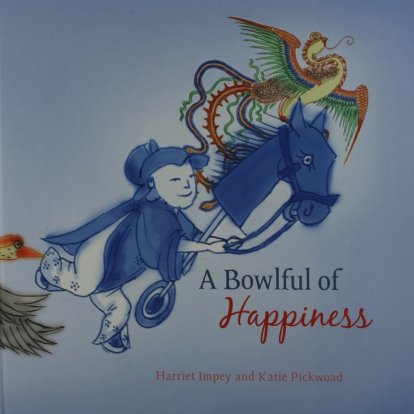
In have added a very special children's book, PGOA object 2010C47ABCDE to my "Book & Catalogues 2", It's title is: A Bowlful of Happiness, and is written by Harriet Impey and Katie Pickwoad.
This children's book captures children's imagination with lively characters taken from real Chinese pocelain pieces. It introduces children to the beauty of Chinese art and the symbolic meanings behind it, as well as bridging cultural divides with a charming and original story. Most of us struggle how to pass through our interest and admiration for Chinese Ceramics to our children or grandchildren.
This book is an absolute must for everyone trying to pass though that interest to a generation soon to become the new caretakers off the pieces we collected with passion and love during our lifetime.

March 2012
The Groninger Museum already had an identically decorated saucer in their collection of Oriental ceramics but the matching teacup was missing, I thought this was a wonderful opportunity to once again complete this unique and very rare set, and decided to donate object 2010609 to their collection of Oriental ceramics.
Sold Ceramics - Sold Japanese wares with Western Designs 1653-1800
Object 2010609
Teacup
Japan
1700-1720
Height 47 mm (1.85 inch), diameter of rim 77 mm (3.03 inch), diameter of footring 35 mm (1.38 inch), weight 59 grams (2.08 ounce (oz.))
Teacup on footring, straight rim. Imari, decorated in underglaze blue, iron-red, black, gold and various other translucent enamel colours. On the outside a riverscape with mountains, houses, flags and pine trees. Two fishermen in a boat on a river. Two farmers walking with a leashed water buffalo near rocks and trees with birds in flight. On a rocky river bank two figures are having a pick nick, besides them on the ground stands a teacup on a footring, a rectangular box with chop sticks and a clearly recognisable bottle with the initials 'FW'. On the bottom in a single circle flowering stems and around the rim a zig-zag lines pattern border.
In 'Fine & Curious' an identically decorated saucer is published. On this saucer we see the same scene with the same two fisherman having a pick nick on a rocky river-bank with besides them on the ground a teacup on a footring, a rectangular box with chop sticks and a clearly recognisable bottle with the initials 'FW'. Jörg states that the initials 'FW' could very well indicate the owner or the contents, for example Franse Wijn (French wine). In this context it is interesting to note that parts of an export teaset are known that have an Imari decoration of a scene of two Japanese pick nicking on a rocky riverbank under a tree. The bottle with the initials 'FW' is clearly recognisable. European objects were greatly desired in Japan and such inscribed bottles, regarded as exotic Western objects, may not only have been made for Dutch clients, but also for the domestic market. It is tempting to imagine that they were used for sake instead of wine. (Jörg 2003/1, p.221, cat. 276a)
A saucer with a similar decoration is known in the Musée Ariana in Geneva. On Japanese porcelain it is already very rare to see an image of a identifiable type of export porcelain, but the image of such a specific object (the bottle with FW initials) is unique. The scene is traditional and does not refer to the Dutch, Decima or the Dutch East India Company (VOC). The two pick nicking figures are Japanese dressed, so it could be obvious that they drink sake (rice wine), so the bottle is in use as a sake bottle. It could very well be that this scene gives a representation of the habits in use in Japan at that time. Upper class people in Japan have always been interested in exotic ceramics and it can be read in VOC documents that Delfts Faience and German stone good were given as presents to high officials in Nagasaki and Edo. In that interest fits the use of a Western object like the bottle. Remains the question, are the initials a coincidence or were they ordered? Did the porcelain painter have a 'FW' bottle as an example which he copied as an exotic object or was there a tea service ordered by a Dutchman, for example for the person who also ordered the original 'FW' bottles? This seems not to be very likely because the commande element is so low prominent something not very likely to fit in that time. It is however so that bottles like this where used by Japanese and Europeans to contain alcoholic beverages. (Jörg 1989/1, pp. 396-407)
Condition: A short hairline to the rim.
References:
Jörg 2003/1, p.221, cat. 276a.
Donated to the collection Oriental ceramics of the Groninger Museum, Groningen, The Netherlands.
November 2011
The $ and £ prices mentioned in the descriptions are appproximates and depend on the € price exchange rate.
 create websites