

Chinese Porcelain
Blue and White wares since 1722
Page 1

Blue and White wares since 1722 - Page 1
Object 2012467
Vase
China
c.1740-60
Height 163 mm (2.84 inch), dimensions foot 55 mm (2.17 inch) x 55 mm (2.17 inch), dimensions belly 65 mm (5.56 inch) x 65 mm (2.56 inch), dimensions mouth 28 mm (1.10 inch) mm x 28 mm (1.10 inch), weight 270 grams (9.52 ounce (oz.))
Vase on square broad flat foot with recessed glazed center, the foot steeply tapering with straight sides to the body of the vase. The four sides spreading to the recessed shoulder which support the four sided neck ending in a everted square mouth. Decorated in underglaze blue with on the foot a lappet border with half flower heads on an underglaze blue ground. On the sides a scholar with a servant in a garden landscape with rocks, trees and plants alternating with a bird perched on a branch of a fruiting pomegranate tree. On the shoulder half flower heads on an underglaze blue ground and on the neck reserves filled with book rolls tied together with a knotted string and a large flower spay alternating with a fruiting spray and a large flower spray.
The vase is of an unusual shape that may have derived from a contemporary Chinese bronze vase. No comparable pieces could be traced in literature. It must have required special skills to make and must have been difficult to fire. The cracks and crackled glaze were was most likely caused by the shape after the firing during the cooling down process.
Condition: The glaze partly crackled and cracked due to the cooling down process after the firing probably caused by the unusual shape, some firing flaws and a fleabite to the outer rim.
Price: € 999 Currency Converter

Blue and White wares since 1722 - Page 1
Object 2011762
Dish
China
1720-1730
Height 30 mm (1.18 inch), diameter 263 mm (10.35 inch), diameter of footring 140 mm (5.51 inch), weight 555 grams (19.58 ounce (oz.))
Dish on footring, flat underglaze brown-edged rim (jia mangkou). Decorated in underglaze blue with a 'vajra' within a swirling clouds pattern border. On the rim knotted motifs alternating with floral scrolls. On the reverse two flower sprays.
Vajra is a Sanskrit word meaning both thunderbolt and diamond. Additionally, it is a weapon which is used as a ritual object to symbolize both the properties of a diamond (indestructibility) and a thunderbolt (irresistible force). The vajra is essentially a type of club with a ribbed spherical head. The ribs may meet in a ball-shaped top, or they may be separate and end in sharp points with which to stab. The vajra is used symbolically by the dharma traditions of Buddhism, Jainism and Hinduism, often to represent firmness of spirit and spiritual power. The use of the vajra as a symbolic and ritual tool spread from India along with Indian religion and culture to other parts of Asia. This dish was probably meant for the Indian market and not for the Western market. (Wikipedia)
For an identically, shaped, sized and decorated dish, please see:
A Japanese dish in the Rijksmuseum Collection (AK-RBK 1972-261) with a very similar type of deoration, is dated 1660-80, for this dish please see:
- Fine & Curious. Japanese Export Porcelain in Dutch Collections, (C.J.A. Jörg, Hotei Publishing, Amsterdam, 2003), p.35, cat. 20.
Condition: Two shallow glaze chips, two shallow glaze frits and various very tiny shallow fleabites all to the reverse rim. A chip or firing flaw to the inner footring.
References:
Price: € 499 Currency Converter

Blue and White wares since 1722 - Page 1
Object 2011681
Tea caddy
China
1720-1730
Height with cover 127 mm (5.00 inch), height without cover 100 mm (3.94 inch), dimensions 82 mm (3.23 inch) x 50 mm (1.97 inch), diameter of mouthrim 20 mm (0.79 inch), weight with cover 259 grams (9.14 ounce (oz.)), weight cover 10 grams (0.35 ounce (oz.))
Tea caddy of rectangular form with canted corners, a flat shoulder with a short upright neck. The flat base is unglazed. The original cover is missing and replaced by a Dutch silver mount (marked). Decorated in underglaze blue with flowering lotus and chrysanthemum plants and grasses on each facet of the body and shoulder.
For a long time during the 17th century tea from China was in fact viewed upon as a kind of exclusive medicine, however after 1680 it quickly became very popular as a beverage among all classes. A cup of tea was often enjoyed both in privacy at home as well as in public tea houses. The latter has even proved to have been a major contribution to women’s emancipation, as it indeed allowed women to freely – and unaccompanied – visit these houses together with their lady friends. Tea was available in all sorts of different qualities, ranging from expensive to cheap. It was imported in great quantities from China – the only country where tea was cultivated in those days – to the Netherlands by the Dutch East India Company.
Following the tea hype, porcelain also made its way to the West: cups with fitting saucers, at first without a handle, later on sometimes with. Apart from a Chinese tea pot, 18th century tea sets often also included a corresponding rinsing bowl, milk jug, spoon tray, sugar pot and tea caddy. These tea caddies were almost invariably made of Chinese porcelain and rectangular or ovoid shaped. They were sometimes embellished with metal mounts. Blue specimens were sometimes repainted in enamel colours in the Netherlands to make them look more appealing. In case a Chinese tea caddy was lost, it could be replaced by one made of Delftware. (Source: The World Indoors. Chinese and Japanese Porcelain. Delft Faience, 17-19th centuries, Groninger Museum, Groningen 9 june 2017 until March 2019)
Condition: A chip to the top edge.
Price: € 249 Currency Converter

Blue and White wares since 1722 - Page 1
Object 2011875
Dish
China
c.1720-1730
Height 29 mm (1.14 inch), diameter of rim 227 mm (8.94 inch), diameter of footring 128 mm (5.04 inch), weight 392 grams (13.83 ounce (oz.))
Dish on footring, convex centre and flat underglaze brown-edged rim (jia mangkou). Decorated in underglaze blue on the convex centre with a vase and a flower spray on a rolled out bookroll surrounded by a pointed leaves-pattern border with waves, rocks, a pagoda, flowering plants and a pomegranate. On the sides four groups of flowering plants. Around the rim a continuous decoration of figures in a landscape engaged in various stages of a duck hunt. On the reverse two flower sprays.
In the collection of the Rijksmuseum Amsterdam are three Chinese Imari decorated dishes with rising convex bases. This type of dish, called a boter bord or 'butter dish' in the Netherlands, is also found in Delft earthenware. Besides a large knob of butter, this specific shape with its raised middle section could also be used for milk-puddings, savarin cakes and similar baked products served with butter or syrup sauces.
For identically shaped dishes, please see:
- Chinese Porcelain, (W.G. Gulland, vol. 1, London 1911), pl. 245.
- Het Chinese porselein in de collectie Frits Lugt / The Frits Lugt collection of Chinese porcelains, (D.F. Lunsingh Scheurleer in Mededelingenblad Nederlandse Vereniging van Vrienden van de Ceramiek, vols. 103/104, Lochem 1981), p.77, cat. 86.
- 300 Treasures, (F. Suchomel, Academy of Arts, Architecture and Design in Prague, Prague, 2015), p.205, cat. 86.
-
Sold Ceramics - Sold Blue and White Kangxi Period 1660-1722 - Dishes - Page 2 - Object 2011435.
Condition: A frit and a hairline to the rim, some shallow frits and chips to the footring.
References:
Lunsingh Scheurleer 1977, cat. 176
Lunsingh Scheurleer 1981, cat. 86
Price: € 399 Currency Converter

Blue and White wares since 1722 - Page 1
Object 2012039
Dish
China
1720-1740
Height 37 mm (1.46 inch), diameter of rim 245 mm (9.65 inch), diameter of footring 138 mm (5.43 inch), weight 418 grams (14.74 ounce (oz.))
Dish on footring, flat underglaze brown-edged rim (jia mangkou). Decorated in underglaze blue with a pheasant on a rock flanked by flowering peony plants and a butterfly with insects in flight. On the sides a ruyi pattern border and on the rim figures in various types of landscapes. The reverse is undecorated.
The pheasant on a rock is a very popular motif on export porcelain and frequently appears on enamelled and underglaze blue Kangxi wares. According to Williams, in the Chinese bureaucratic hierarchy officials of the second grade had a gold pheasant embroidered on their court robes, those of the fifth grade a silver pheasant. The bird was represented as standing on a rock, looking towards the sun, the imperial symbol of authority. (Williams 1976, pp.322-323), (Jörg & Van Campen 1997, p.157)
For other objects decorated with the pheasant on a rock design, please see:
Condition: Two firing flaws and a fleabite and frit to the (reverse) rim.
References:
Jörg & Van Campen 1997, cat. 171
Price: € 499 Currency Converter

Blue and White wares since 1722 - Page 1
Object 2011972B
Dish
China
1735-1745
Height 32 mm (1.26 inch), diameter of rim 214 mm (8.43 inch), diameter of footring 108 mm (4.25 inch), weight 332 grams (11.71 ounce (oz.))
Dish on footring, flat rim. Decorated in underglaze blue with a peacock perched on a rock surrounded by pierced rockwork with flowering plants and a bird in flight. On the sides reserves outlined with scrolling spiky lotus leaves and filled with a bird on a flowering branch or a shell filled with flowering branches and ribbons. On the reverse two bamboo sprays.
Condition: Some glaze rough spots frits, fleabites and a chip to the reverse rim.
Price: € 399 Currency Converter

Blue and White wares since 1722 - Page 1
Object 2011881
Dish
China
1730-1745
Height 28 mm (1.10 inch), diameter of rim 220 mm (8.66 inch), diameter of footring 115 mm (4.53 inch), weight 318 grams (11.22 ounce (oz.))
Dish on footring, flat underglaze brown-edged rim (jia mangkou). Decorated in underglaze blue with a central flowerhead in a circular roundel surrounded by four groups of flowers. On the rim a border of swags and crowns. On the reverse three flower sprays.
The border with swags and what appear to be crowns suggest an European design as source of inspiration for the decoration on this dish.
Condition: A fleabite to the footring and some very tiny fleabites to the reverse rim.
Price: € 349 Currency Converter

Blue and White wares since 1722 - Page 1
Object 201014
Saucer
China
1723-1735
Height 21 mm (0.82 inch), diameter of rim 113 mm (4.45 inch), diameter of footring 56 mm (2.20 inch), weight 70 grams (2.47 ounce (oz.))
Saucer on footring, flat rim. Decorated in underglaze blue with two courting cranes. Round the interior rim a stylized laurel leaves pattern border. The reverse is undecorated. The matching teacup is missing.
The crane (Grus montignesia) itself is an auspicious symbol, representing longevity and wisdom. They accompany Daoist immortals (xian, hsien) bringing from The Isles of Paradise the tablets in their beaks. A pair of cranes symbolizes 'Long Marriage' as cranes mate for life. (Pijl-Ketel 1982, p.279)
Among the ceramic cargo of the Ca Mau shipwreck (1725) almost identical shaped and decorated teacups and saucers with the so-called 'Courting Cranes' pattern were found. (Amsterdam 2007, pp.116-117)
Condition: A hairline and two frits to the rim.
References:
Price: € 149 Currency Converter

Blue and White wares since 1722 - Page 1
Object 2011692
Bowl
China
1850 or later
Provenance: The George Eumorfopoulos Collection of Chinese, Corean & Persian Pottery & Porcelain.
Height 57 mm (2.20 inch), diameter of rim 146 mm (5.59 inch), diameter of footring 46 mm (2.20 inch), weight 144 grams (5.08 ounce (oz.))
Bowl on footring, slightly flaring rim. Decorated in underglaze blue with the Taoist Triad, three figures representing Tu (happiness), Lu (Official Advancement) and Shou (Longevity) in a fenced garden landscape. The interior with a stylised pine tree, a deer and lingzhi in a double cirle. Marked on the base with the highly stylised four character mark Hung-hsi, nien chieh. On the interior wall an old oval paper collectors label from George Eumorfopoulos with the handwritten collectors number C.159, in black ink.
The design on this bowl is unusual and the stylised mark can be considered extremely rare. The bowl is apparently over fired creating the cracked ice motif of the glaze.
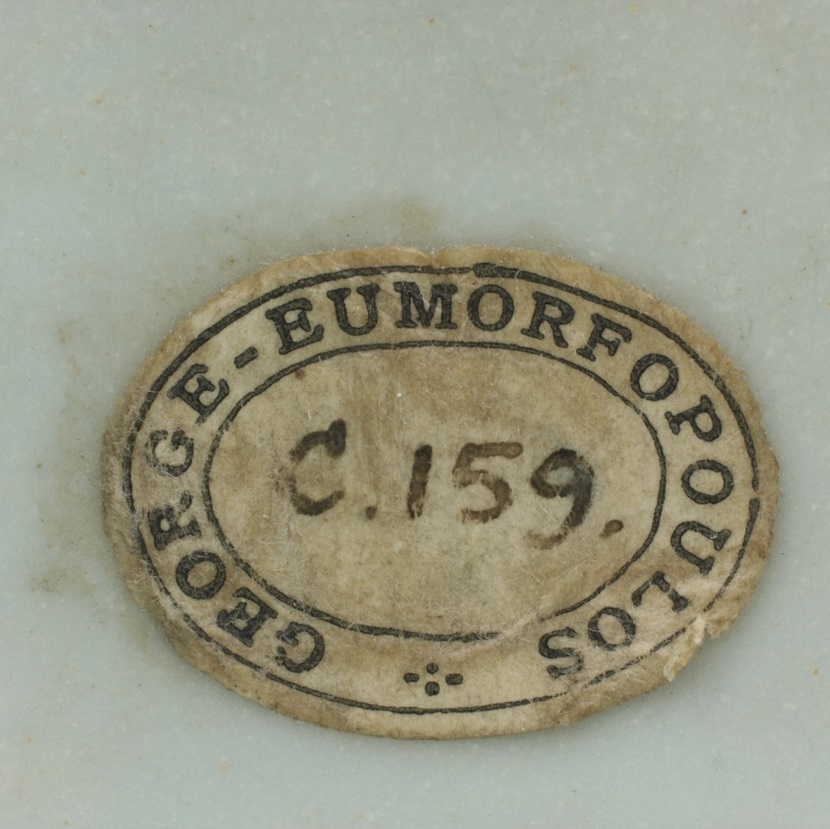
George Eumorfopoulos was a distinguished collector of European and Oriental porcelain. He was born in Mount Pleasant, Liverpool, on 18 April 1863, the son of Aristides George Eumorfopoulos and Mariora Scaramanga. He worked for the merchant firm of Ralli Brothers, where he rose to the position of Vice-President before retiring in 1934. He initially collected European porcelain before moving on to create a renowned collection of early Chinese art, encompassing porcelain, archaic bronzes and jades, and sculpture and paintings. Eumorfopoulos turned a part of his house on Chelsea Embankment into a private museum to display these works of art, which attracted many visitors. Eumorfopoulos was a member of the Victoria & Albert’s Advisory Council from 1925 to 1935, and was a founder of the Oriental Ceramic Society and its first president from 1921 until his death in 1939. In 1934 he sold his collection at below market value to the British Museum and the Victoria and Albert Museum. (source: www.vam.ac.uk)
In the 1920's this bowl was regarded as export quality and dated 15th Century. The original George Eumorfopoulos collectors label states that this bowl was considered to be special enough by a collector of the stature of George Eumorfopoulos to take this bowl up in his prestigious collection. In Hobson's 'The George Eumorfopoulos Collection of Chinese, Corean & Persian Pottery & Porcelain' (1925-1928) the whole C-section is about early ceramics (Chün) but it does not include a number C.159. To my knowledge there have been no later subsequent catalogus created-except for the Bluett & Sons's 'Chinese Pottery and Porcelain from the Eumorfopoulos Collection' (1935) sale catalogue and the Sotheby's 'The Eumorfopoulos Collections. Catalogue of Persian Ceramics & Islamic Glass, Egyptian, Greek and Roman Antiquities, Choice Medieval & Renaissance Works of Art etc. formed by the late George Eumorfopoulos.'' (1940)
It is now recognised as an academically interesting piece of provincial Chinese blue-and-white made for the domestic market in Fujian Province (i.e. not in Jingdezhen) a lesser known manufacturing centre. It can be dated mid or second half 19th Century.
Condition: Perfect.
Reference:
Price: € 499 Currency Converter
 create websites